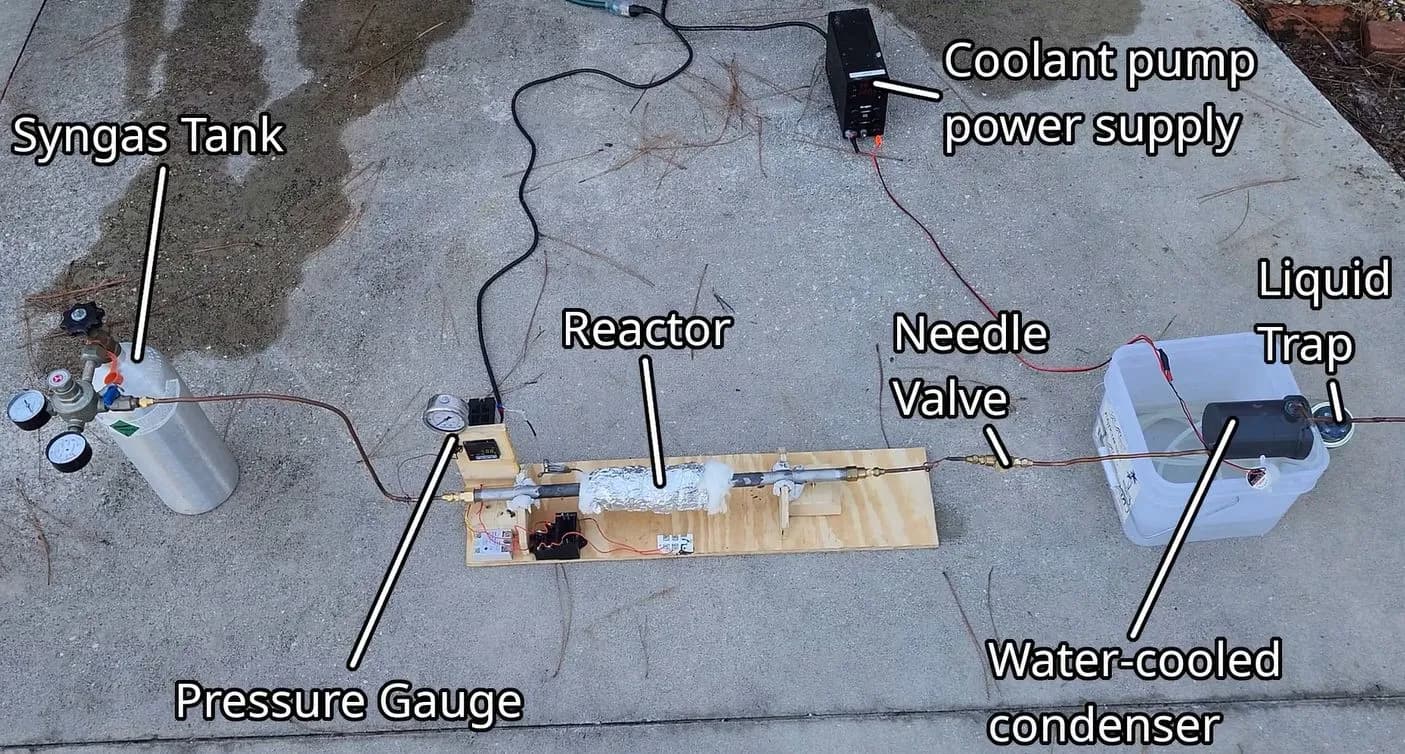
DIY Fischer-Tropsch synthesis is harder than it looks. YouTuber Hyperspace Pirate built a working F-T reactor using an iron-based catalyst packed inside a steel tube, fed syngas (carbon monoxide and hydrogen), and produced only a few milliliters of pentane and hexane, with the remainder being gaseous methane and ethane. That output signals a low alpha value, the key parameter governing hydrocarbon chain length in F-T reactions.
Alpha is set by reactor temperature and pressure during synthesis. A low alpha terminates chains early, yielding mostly methane (CH4). A high alpha builds longer hydrocarbon chains before hydrogen termination. The reaction is exothermic, so controlling temperature without runaway is the central engineering problem. In this build, a heater kicks off the reaction and is then switched off, leaving the process to self-regulate.
The video is worth watching in full because the real argument is not just about one reactor run. Hyperspace Pirate works through whether targeting a specific hydrocarbon via precise alpha control is even practical at DIY scale, or whether running high-alpha F-T to produce crude oil and then distilling it conventionally is the more achievable path. The answer shapes every design decision in synthetic fuel production from the ground up.
[READ ORIGINAL →]