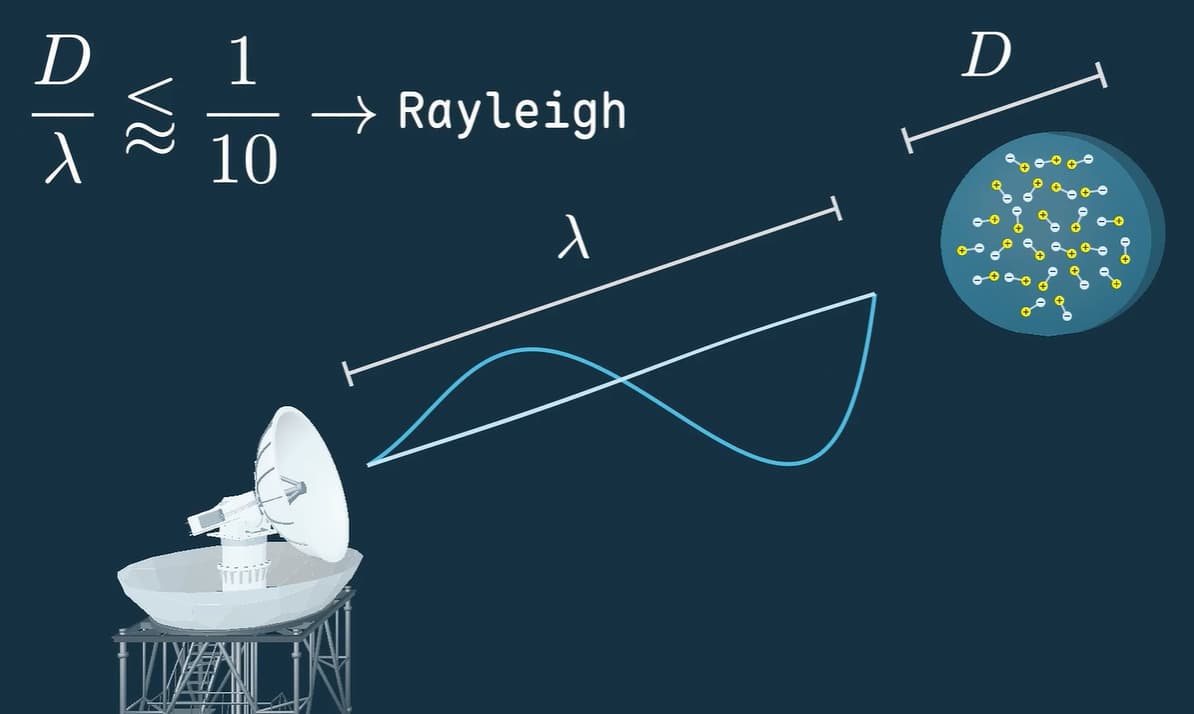
Raindrops behave as dipole antennas. When electromagnetic radiation passes through a water droplet, the neutral molecular alignment breaks down and the droplet oscillates at the incoming frequency. The backscattered signal that returns to the source, such as a weather radar, is determined by two variables: the volume and permittivity of the droplet. That relationship is the core of the Rayleigh regime, and it governs both radar performance and signal loss in rainy conditions.
Marshall Bruner's video breaks down the physics with enough rigor to be useful. The Rayleigh regime connects directly to Rayleigh scattering, the same mechanism responsible for blue skies in the visible spectrum. Understanding the regime matters because it sets the boundary conditions for when a raindrop acts as a reflector versus an absorber, which determines whether precipitation helps or degrades your signal, and by how much. Bruner also extends the model to snow detection, where permittivity differs significantly from liquid water.
The video is paired with a Python notebook at notebooks.marshallbruner.com/dsd that makes the mathematics interactive and reproducible. If you work in RF engineering, remote sensing, or radar systems, the notebook alone justifies the click. The full treatment of drop size distribution and its effect on backscatter cross-section is where this resource separates itself from a surface-level explainer.
[READ ORIGINAL →]