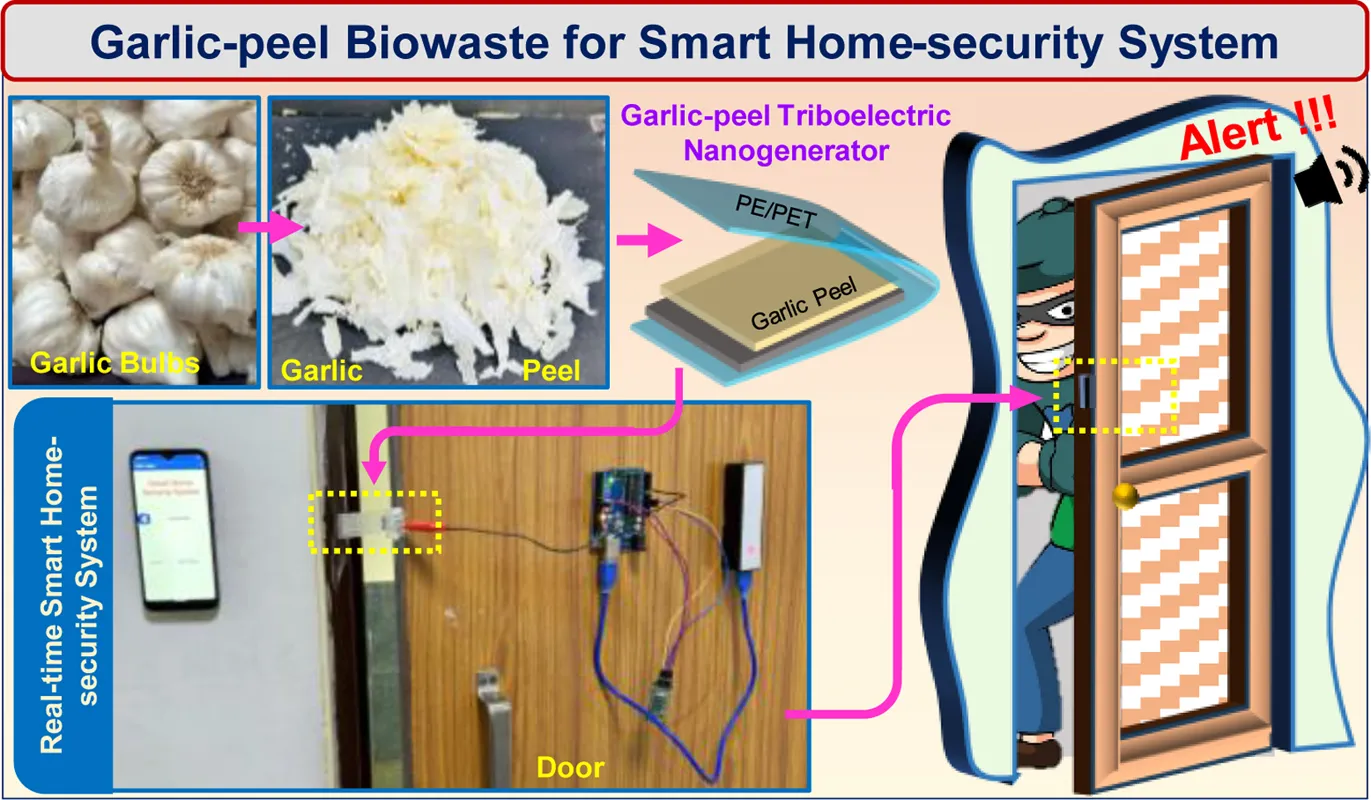
A door sensor built by Manas Tiwari and Deepak Bharti generates 210 VAC and 45 µA of short-circuit current from a single door opening, using nothing but garlic peel and a polyethylene sheet. The mechanism is the triboelectric effect: two dissimilar materials exchange charge on contact and separation. A dual-layer garlic peel configuration pushes output to 400 VAC and 65 µA. No battery required to generate the signal.
The garlic peel forms the positive electrode of what the researchers call a triboelectric nanogenerator, or TENG. The sensor survived 200 stress cycles and remained functional after six months in storage. The full paper is paywalled on IEEE Xplore, but IEEE Spectrum published the core technical details. The current prototype still offloads detection logic to an MCU powered by a separate powerbank, which does not solve the battery dependency problem entirely.
What makes this worth reading is the gap between what the sensor generates and what it currently powers. The output levels are high enough to trigger a low-power wireless packet, something closer to an energy-harvesting Zigbee or LoRa node, without any stored energy at all. The researchers have not closed that loop yet. Someone will.
[READ ORIGINAL →]