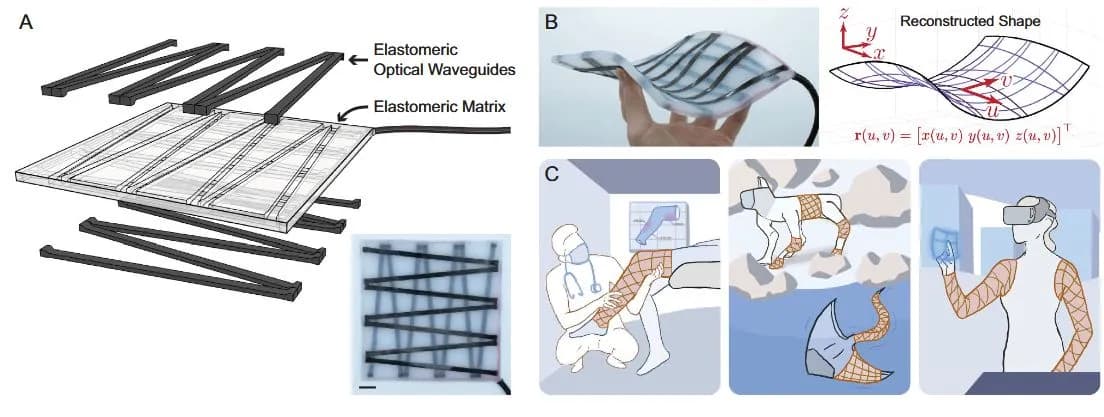
Researchers have built a shape-sensing sheet using elastomeric optical waveguides arranged in a double-sided, overlapping zig-zag pattern. Qifan Yu et al., publishing in Advanced Intelligent Systems, demonstrated the system by wrapping it around a volunteer's arm, elbow, and hand, successfully detecting flexion and movement at individual joints. No external cameras. No motion capture rigs.
The mechanism is direct: light propagation through each waveguide changes as the material deforms, and an algorithm reconstructs the sheet's 3D geometry from those signal changes. The waveguides are custom elastomeric, not off-the-shelf fiber optic, which keeps the material flexible enough to conform to curved surfaces. The double-sided zig-zag layout is the specific architectural choice that makes full-sheet shape reconstruction tractable, and the paper's treatment of that geometry is worth reading in detail.
The current prototype is bulky and runs an unoptimized reconstruction algorithm, but the path to miniaturization points toward waveguides woven directly into standard fabric. That means continuous, passive shape sensing for robotic limbs, VR body tracking, or medical motion monitoring without battery-heavy IMU arrays or line-of-sight camera dependencies. The gap between this lab result and a wearable product is engineering, not physics.
[READ ORIGINAL →]