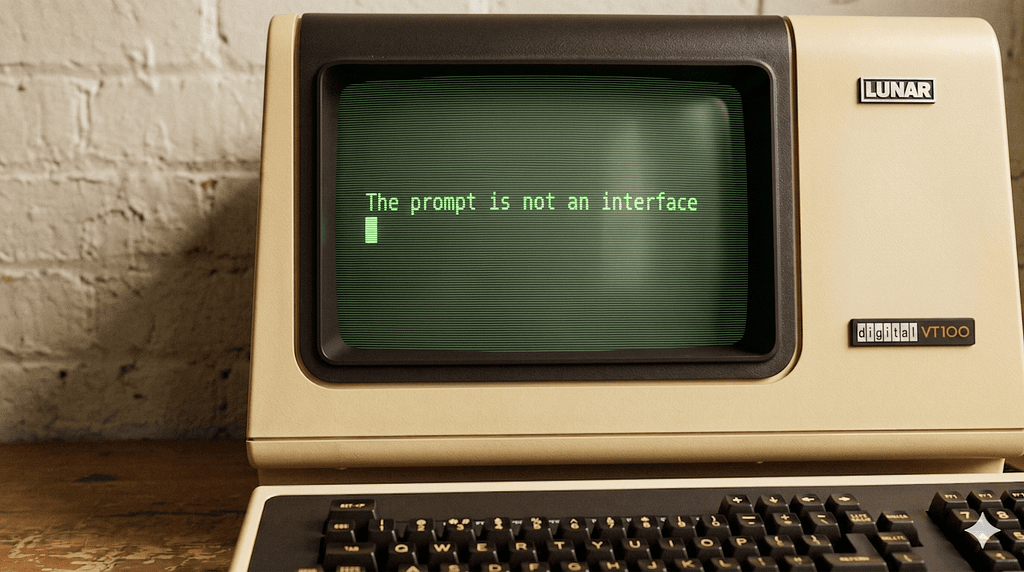
The most advanced AI systems ever built communicate through a blinking cursor in an empty text box. That is not progress. For forty years, interface design moved in one direction: away from typed commands and toward direct manipulation. Ivan Sutherland drew on a screen with a light pen in 1963. Douglas Engelbart demonstrated the mouse in 1968. The 1984 Macintosh made computing legible to anyone without a manual. Ben Shneiderman codified why this mattered in his Eight Golden Rules in 1983: reduce memory load, provide feedback, keep users in control. The AI prompt interface violates nearly all of them.
The regression is not cosmetic. It is structural. Allan Paivio's 1971 dual coding theory established that visual and verbal information run on separate cognitive channels, and the visual channel processes an image in as little as 13 milliseconds. For spatial, compositional, and visual tasks, the text prompt forces a lossy translation at every step. Creative professionals are being asked to encode intent that has no clean verbal form into syntax, then decode the output back into vision. Signal is lost twice. The original article walks through exactly how much, and why this matters beyond inconvenience.
This piece is worth reading in full not for its conclusion but for its evidence. The historical arc from the VT100 terminal to Sketchpad to System 1 is laid out with precision, and the case it builds is specific: the prompt is not a neutral interface choice. It is a regression with real costs, and the field has not reckoned with them. The question the author leaves open, what a genuinely visual AI interface would require, is the one the industry has not seriously tried to answer.
[READ ORIGINAL →]