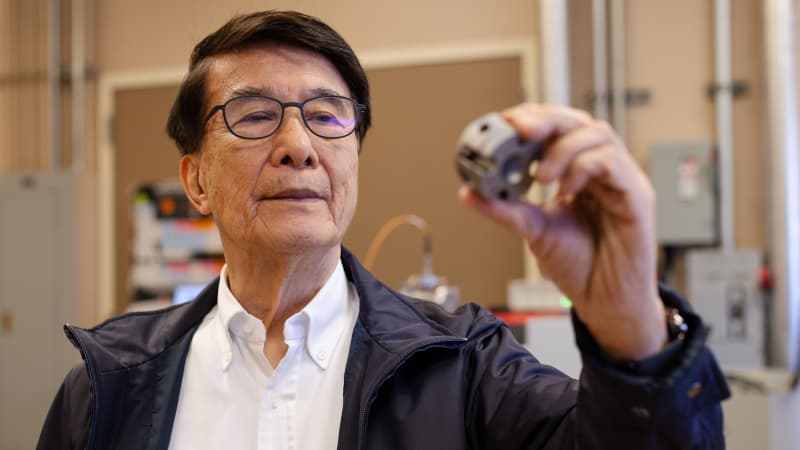
Researchers at Argonne National Laboratory and the University of Houston have pushed the ambient-pressure superconducting temperature record to 151 K, up 18 K from the previous benchmark of 133 K. The material is HgBa2Ca2Cu3O8, known as Hg1223, a cuprate that has been studied since the 1990s. The method is called a pressure-quench protocol: cool the sample under crushing pressure, then release that pressure suddenly, locking in the high-pressure structural state without the pressure itself.
The significance is not the number alone. It is that a procedural intervention, not a new material, produced the gain. Room-temperature superconductors exist today but require pressures that destroy any practical application. This result demonstrates that some of the electronic properties induced by those pressures can survive decompression, which reframes the research problem from materials discovery to structural engineering.
The full paper by Liangzi Deng et al. is published in PNAS Physics and is worth reading for the protocol mechanics and the structural analysis that explains why the Tc shift persists. The question the paper raises, and does not fully close, is how far this approach can be pushed with Hg1223 or applied to other cuprate families.
[READ ORIGINAL →]