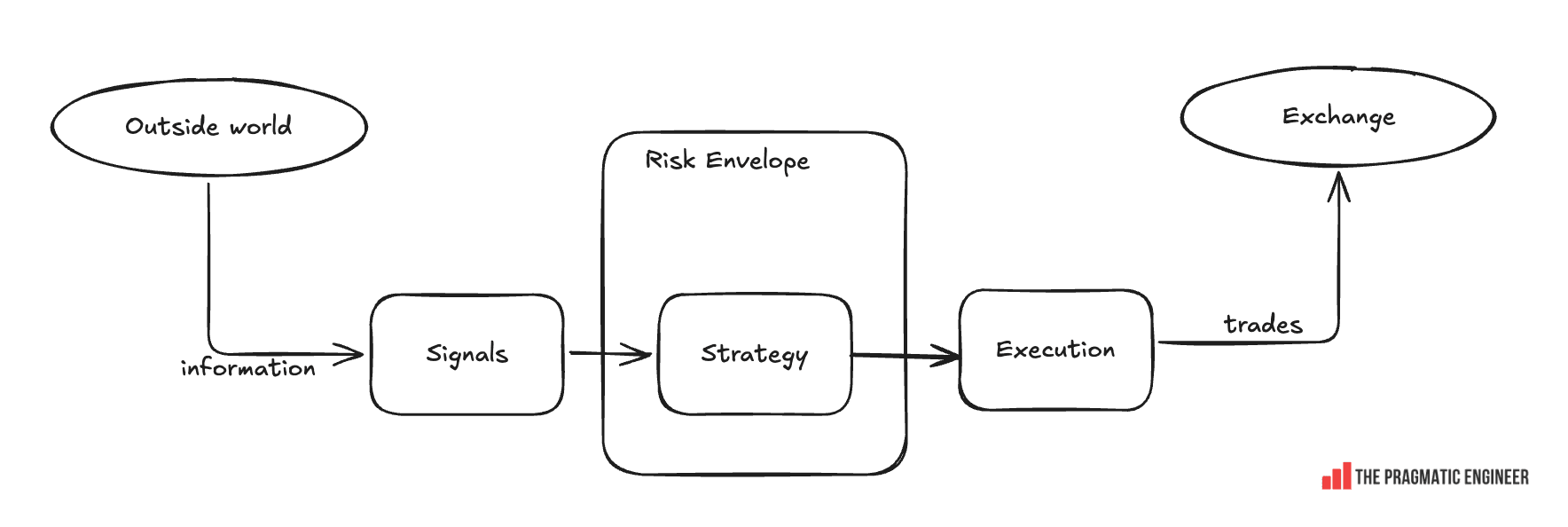
Proprietary trading firm Optiver, headquartered in Amsterdam with major US operations, pays compensation at or above Big Tech rates because nanoseconds are not a metaphor. They build custom FPGAs, manufacture their own hardware, lease dedicated fiber and optical wavelengths, and run AI models at the network edge to make real-time trade decisions. A single software bug at competitor Knight Capital in 2012 triggered a $440 million loss in hours and nearly ended the company. That ghost haunts every engineering decision at firms like Optiver.
The Pragmatic Engineer interviewed Optiver CTO Alex Itkin, Head of Global Platform Engineering Pat Cooney, and Options Technology Lead David Gross to produce this report. The structure is unusually complete: eight sections covering the full stack from silicon to AI tooling, including CI/CD pipelines, the three-layer software architecture, FPGA customization, AMD hardware partnerships, and how Optiver shifted from hiring mostly junior engineers to targeting experienced ones. The company has no external customers. Its own trading operation is the customer, which removes product deadlines but raises the stakes on every deployment.
The piece is worth reading in full because the technical detail is specific enough to be useful. Low latency is no longer the sole differentiator; Optiver now runs slow information models with fast execution triggers alongside fast models at the network edge, and the article explains the engineering tradeoffs behind both approaches. The section on risk management versus deployment speed is particularly sharp, and the AI tooling section includes adoption details that go beyond the usual vendor announcements. This is a rare ground-level look inside a category of company that almost never talks publicly about how it works.
[READ ORIGINAL →]