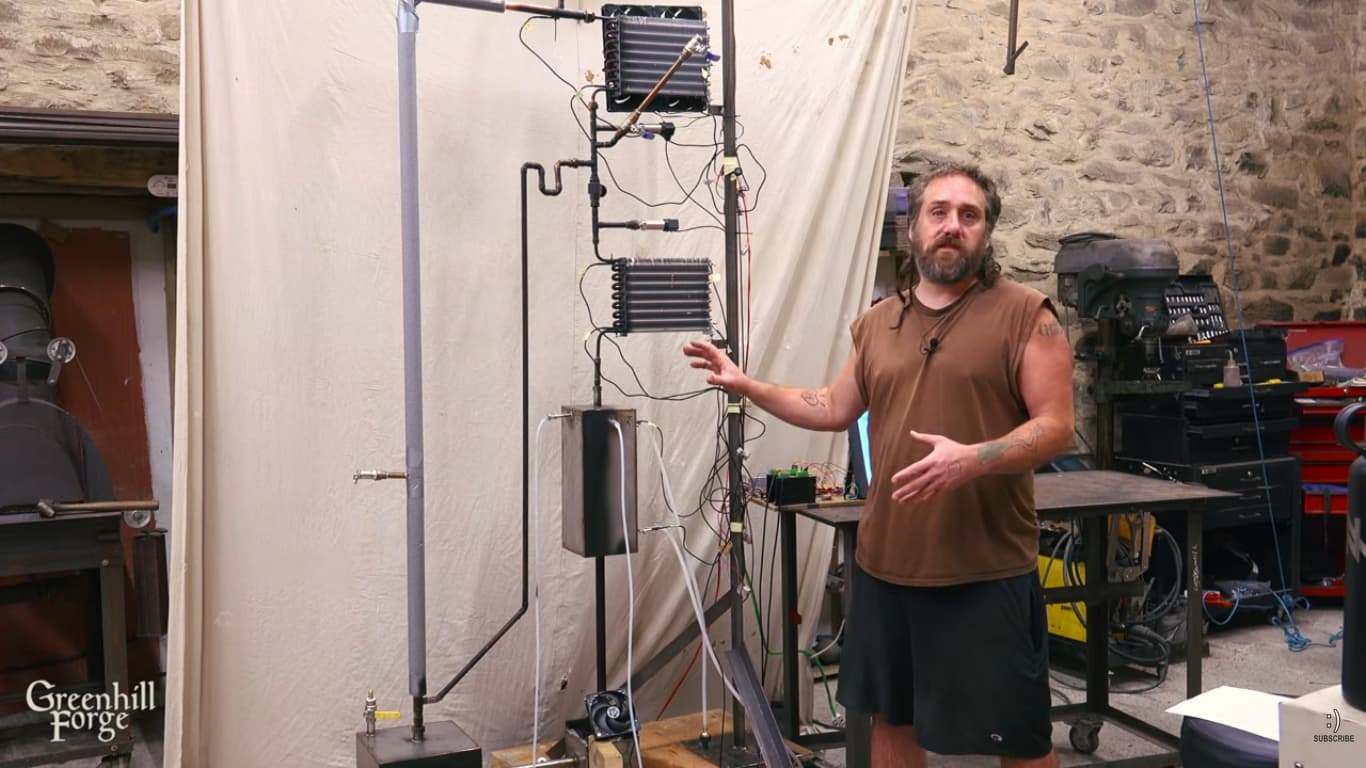
Greenhill Forge built a fire-powered absorption cooler that reached 5 degrees Celsius in a 16-degree ambient environment using water, road salt, and combustion heat as the primary energy source.
The system runs three distinct loops: a generator loop heats a saltwater solution to boil off water vapor, a condenser receives that vapor, and an absorber section held at very low pressure causes the water to flash-boil and pull heat from the target space. The salt solution then scavenges the vapor and removes it. Pumps and fans draw a small electrical load, covered easily by a solar panel or battery. No exotic refrigerants, no grid connection.
The result is not yet refrigerator-grade cold, but the engineering path to get there is the story worth reading. The original article details the pressure management, the valve sequencing, and the sensor suite Greenhill Forge used to monitor and control the system. This is absorption cooling stripped to its fundamentals, and the gap between 5 degrees and the 4-degree food-safe target is a solvable engineering problem, not a physics barrier.
[READ ORIGINAL →]