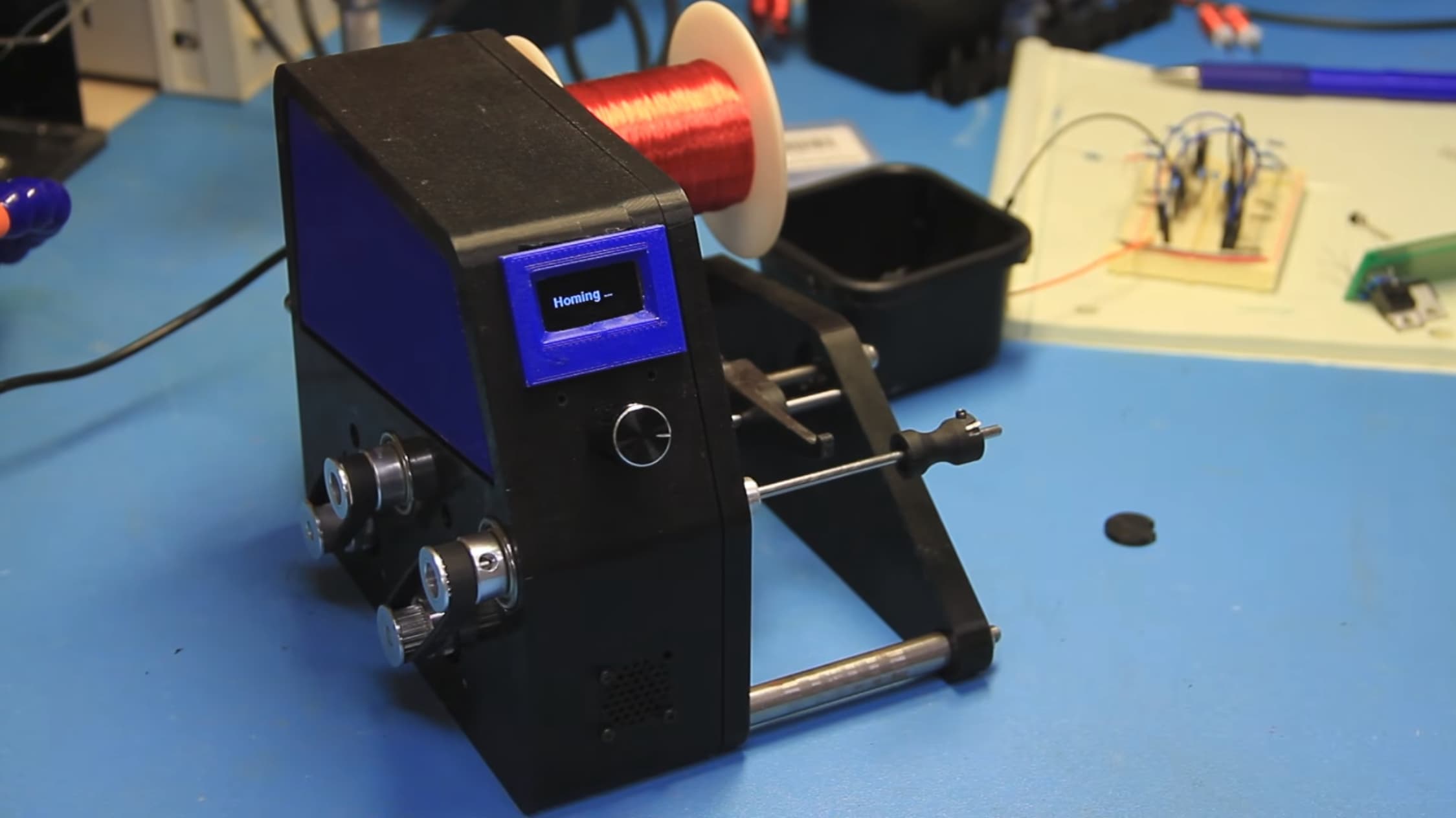
Larry built a dedicated coil-winding machine to supply the two electromagnetic coils required per dot in a custom flip-dot matrix display. Winding by hand at that scale is not viable. The machine solves the problem with two stepper motors: one rotates the bobbin, one drives a wire guide carriage back and forth to distribute wire evenly across the bobbin surface.
The hardware details are worth studying. The wire spool runs on bearings, tension comes from two foam pads with adjustable pressure, and the frame is mostly 3D-printed around metal rods, bearings, and belt drives. A Teensy microcontroller handles sequencing, paired with an OLED display and a rotary encoder for input. On startup the carriage homes against an end-stop switch, then the machine winds in discrete layers, counting each one as it goes.
The flip-dot application driving this build adds context that the machine alone does not. Larry's display design, linked in the original article, explains why coil uniformity and repeatability matter at scale. For anyone building custom actuators, motors, or displays, the full writeup and embedded video cover the mechanical tradeoffs in enough detail to replicate or adapt the design.
[READ ORIGINAL →]