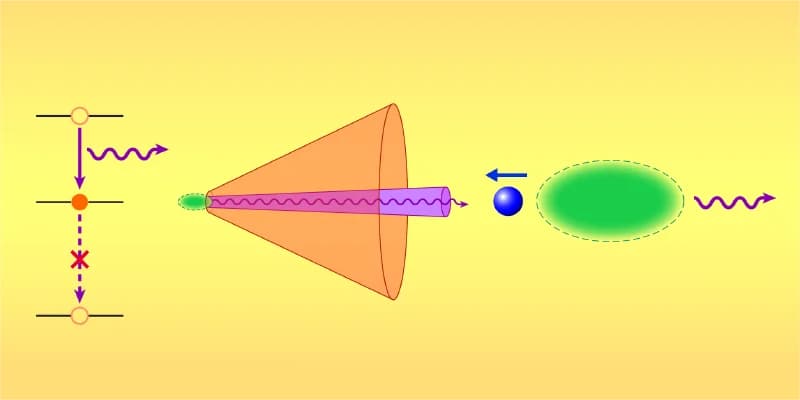
Two MIT papers have effectively killed the neutrino laser concept. Yu-Kun Lu et al., publishing in Physical Review Letters, calculated that superradiance cannot occur when neutrinos are emitted from a Bose-Einstein condensate of radioisotopes. A second PRL paper by Hanzhen Lin et al. confirmed that a BEC environment does not enhance radioactive decay rates at all. Ana Maria Rey et al. reviewed both findings in Physics.
The core problem is physics, not engineering. Photons used in conventional laser superradiance carry roughly 1 eV of energy and travel slowly enough to synchronize neighboring atoms in a BEC. Neutrinos carry 1 MeV or more and exit at near-light speed, delivering a recoil kick to the emitting nucleus before any collective quantum effect can propagate through the condensate. The BEC has no time to respond, and coherence never builds.
The review by Rey et al. in Physics is the piece worth reading in full. It does not just summarize the two papers, it maps exactly where the analogy between photon superradiance and neutrino emission breaks down and why. The argument is subtle enough that the concept survived decades of speculation before these calculations closed it off.
[READ ORIGINAL →]