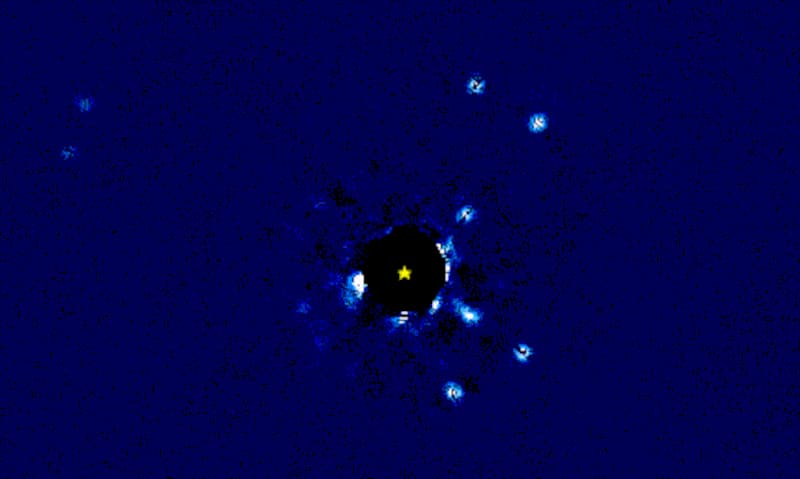
Astronomer Jason Wang has published direct imaging videos of exoplanets in orbit, assembled from sparse observational data spanning up to 17 years. One sequence uses 30 images collected over 17 years. Another uses 10 frames from the Keck Observatory over 12 years. These are not simulations. They are reconstructions of real planetary motion around real stars.
The method is motion interpolation, the same technique used in video editing and consumer televisions, applied to multi-year gaps between telescope observations. The planets move slowly, with orbital periods measured in decades, and follow Kepler's laws precisely enough to make interpolation valid. That predictability is what makes the reconstruction defensible, and the original page explains exactly where the assumptions live.
Wang's visualizations have contributed to peer-reviewed papers on arxiv, including work on orbital dynamics and direct imaging methodology. The gap between 'no evidence of exoplanets' and 'watch one orbit in real time' closed faster than most expected. Read the full breakdown at jasonwang.space/orbits.html to understand what the images actually required to produce.
[READ ORIGINAL →]