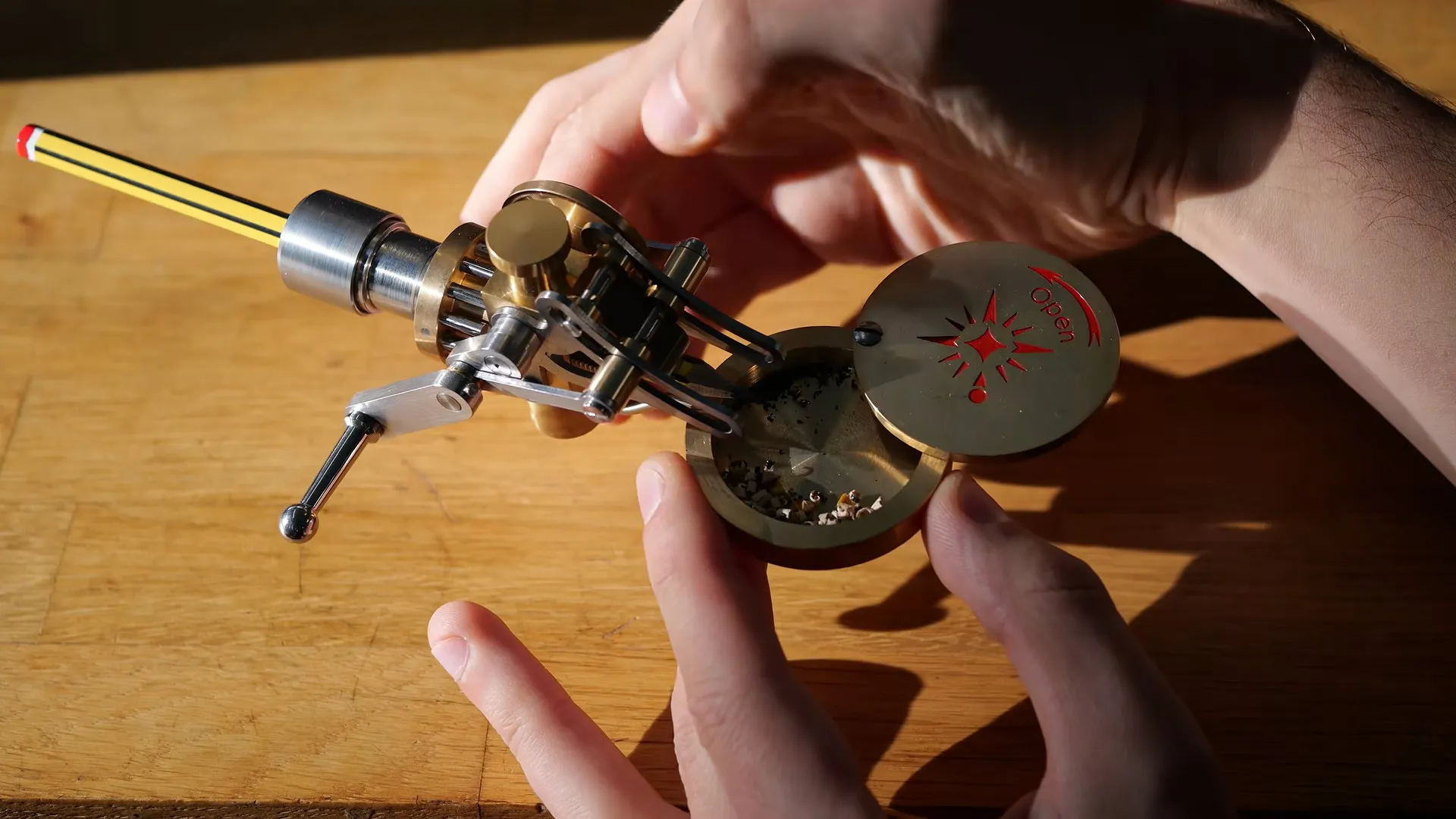
Chronova Engineering built a reciprocating pencil sharpener from scratch to produce a concave cone tip, a geometry impossible with rotary sharpeners and trivial with a knife. The mechanism automates knife whittling, a concept documented as far back as 1910. A blade rides two curved tracks to form the concave profile, driven by a camshaft and crank. Early tests confirmed the cut geometry works. The missing piece was pencil rotation.
To solve rotation, Chronova designed a custom intermittent mechanism inspired by the Geneva wheel, but with input and output shafts at 90 degrees to clear the blade path. An indexing pinion drives a lantern pinion, advancing it two teeth per full crank rotation. By specifying an odd tooth count on the lantern, the number of usable index positions doubles. Between advances, the lantern locks solid. The pencil rides a collet chuck on a lead screw coupled to the lantern output, feeding forward incrementally with each crank turn.
The machine works. It also takes far too long and demands real effort to sharpen a single pencil. Chronova admits it is not practical. Read the full piece for the CAD breakdown of the lantern pinion geometry and the specific track curvature math that produces the concave cone, because that is where the actual engineering lives.
[READ ORIGINAL →]