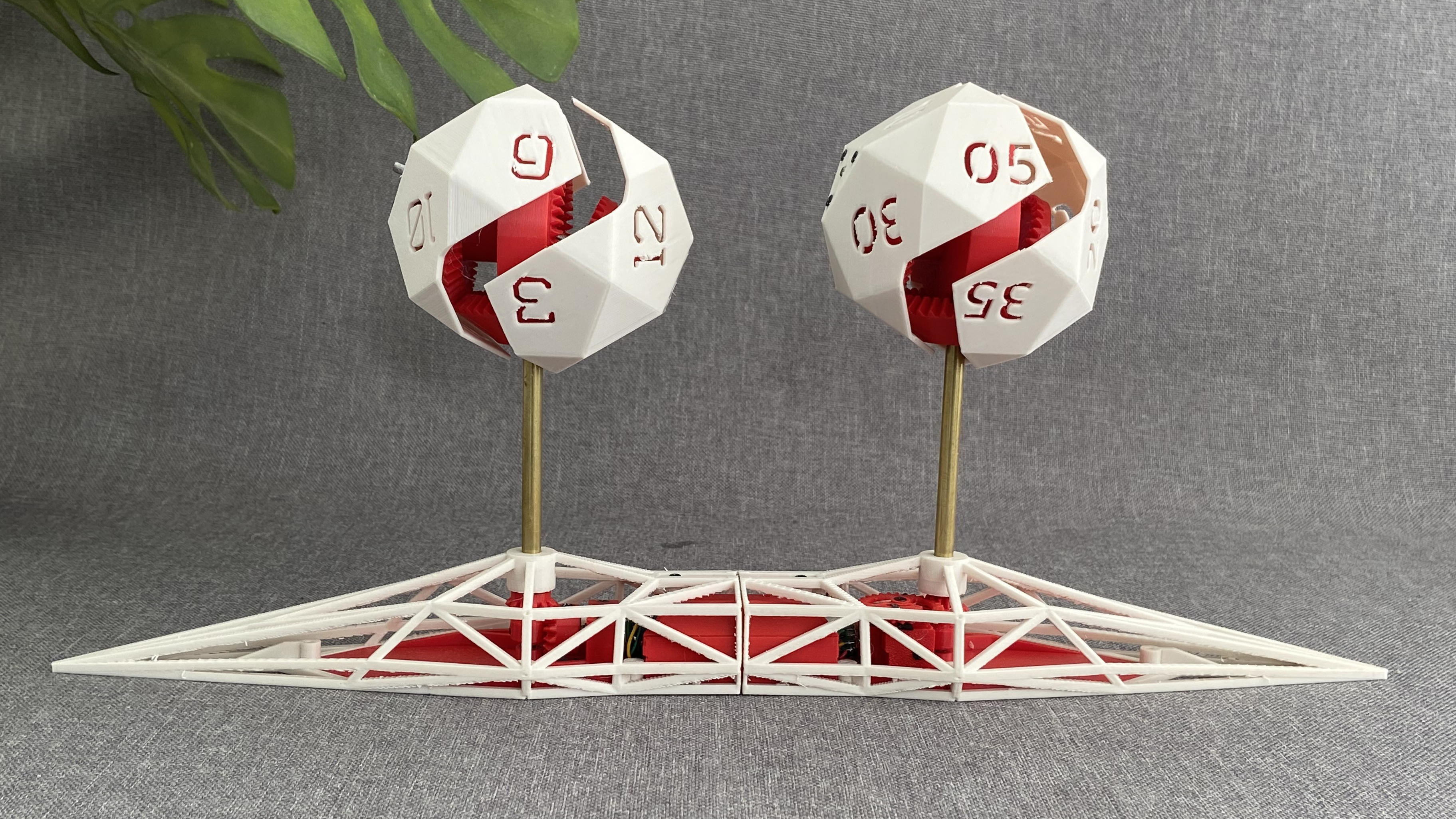
OVODYO, built by ekaggrat singh kalsi, tells time by tumbling two 3D-printed icosahedra, each with numerals sunk into all twelve faces. An ATmega8 microcontroller drives two stepper motors via DRV8833 motor drivers, spinning each icosahedron around two axes until the correct face lands upright. A hall effect sensor tracks position. Because the minutes dial only resolves to five-minute intervals, an LED strip fills the gap for exact minutes.
The mechanical design is worth studying in detail. Each icosahedron sits on a brass support shaft with an inner drive shaft running through its center to power a beveled gear set. A split path cut around each shell exposes the red internal gearing while still allowing full rotation around the support shaft. The geometry of icosahedral rotation ensures only one numeral set reads upright at any given position, which is not a given with 20-faced polyhedra and required deliberate design choices.
Kalsi has a documented history of unconventional timekeeping, including a chain-link sculpture clock, a hair-tie clock, and a mechanical seven-segment display. OVODYO is the most mechanically dense of the set. The full project log on Hackaday.io breaks down the gear train geometry and rotation sequencing, which is where the real engineering argument lives.
[READ ORIGINAL →]