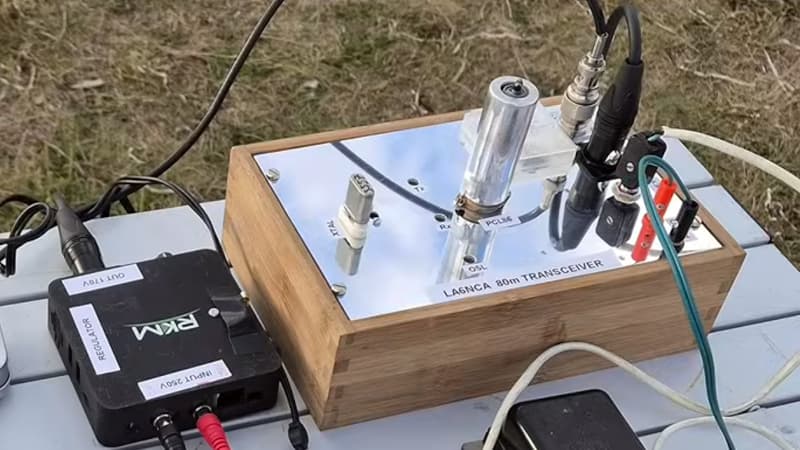
Helge Fykse built a complete transceiver using a single PCL86, a tube originally designed for the audio output stage of 1960s European television sets. The PCL86 is a dual-function device: a small-signal triode and a power pentode in one glass envelope, the vacuum-tube equivalent of the LM386. Its 300 mA series heater, denoted by the 'P' prefix in the Pro-Electron naming system, made it ubiquitous in consumer TV hardware and makes it cheap and widely available today.
The circuit does real work with minimal parts. On transmit, the pentode drives a crystal-controlled power amplifier. Flip a switch and the same tube reconfigures into a direct conversion receiver: the triode handles oscillation and mixing, the pentode handles audio amplification. The original article raises an unresolved question about whether the receiver section radiates unintentionally, and concedes the energy would likely be negligible. That open question alone is worth understanding before you build one.
The full video walkthrough covers the circuit in granular detail, which is where this project earns its time. If a transceiver is more than you need, the PCL86's canonical application is a stereo audio amplifier, and Hackaday has covered that path too. Either way, this is a concrete entry point into tube circuit design using hardware that costs almost nothing.
[READ ORIGINAL →]