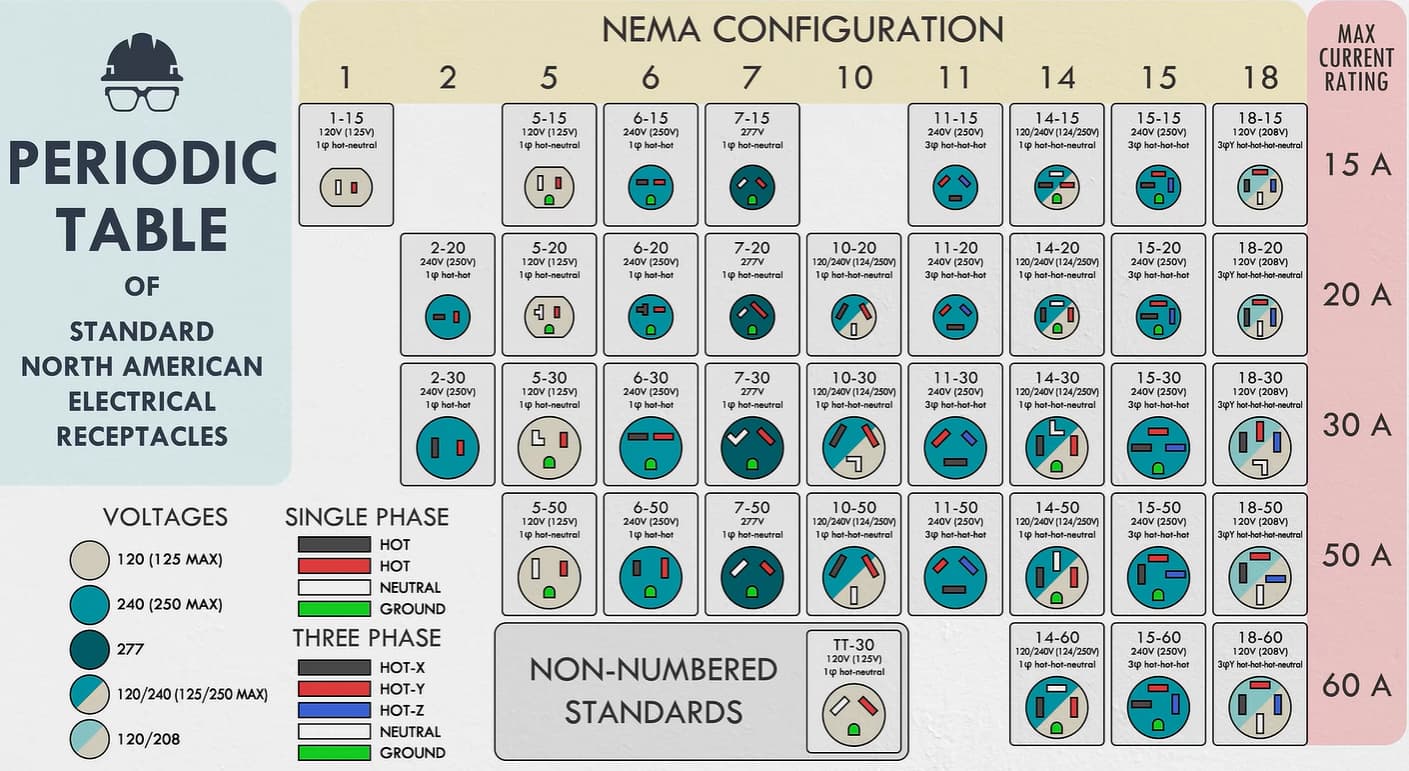
The NEMA connector catalogue contains far more than the two receptacles most Americans ever touch. Practical Engineering mapped the entire zoo into a periodic-table-style graphic, revealing how many of those defined standards exist purely on paper versus seeing real-world use. The National Electrical Manufacturers Association, founded in 1926, governs these standards across the US, Canada, Mexico, and Japan, but a Japanese 1-15-style plug is not guaranteed to mate safely with a US NEMA 1-15 outlet even before you account for voltage and frequency differences.
The proliferation of NEMA types is not accidental. The association built a one-connector-per-combination philosophy: distinct designs for each polarity configuration, current rating, and voltage level, covering nearly half a dozen voltages in common US use. NEMA connectors are also consistently polarized, unlike the European Type E and F standards, which push polarity handling onto the device itself. That design choice alone explains much of the catalogue's sprawl.
The full video breaks down which combinations are live in the field and which are effectively dead standards, and that gap is the reason to watch it. There is also a pointed comparison to the global connector landscape, including the NEMA 5-15's known vulnerability to the penny challenge exploit and Thailand's decision to design its own national connector rather than adopt the widespread Type F. The periodic table graphic alone is worth pulling up.
[READ ORIGINAL →]