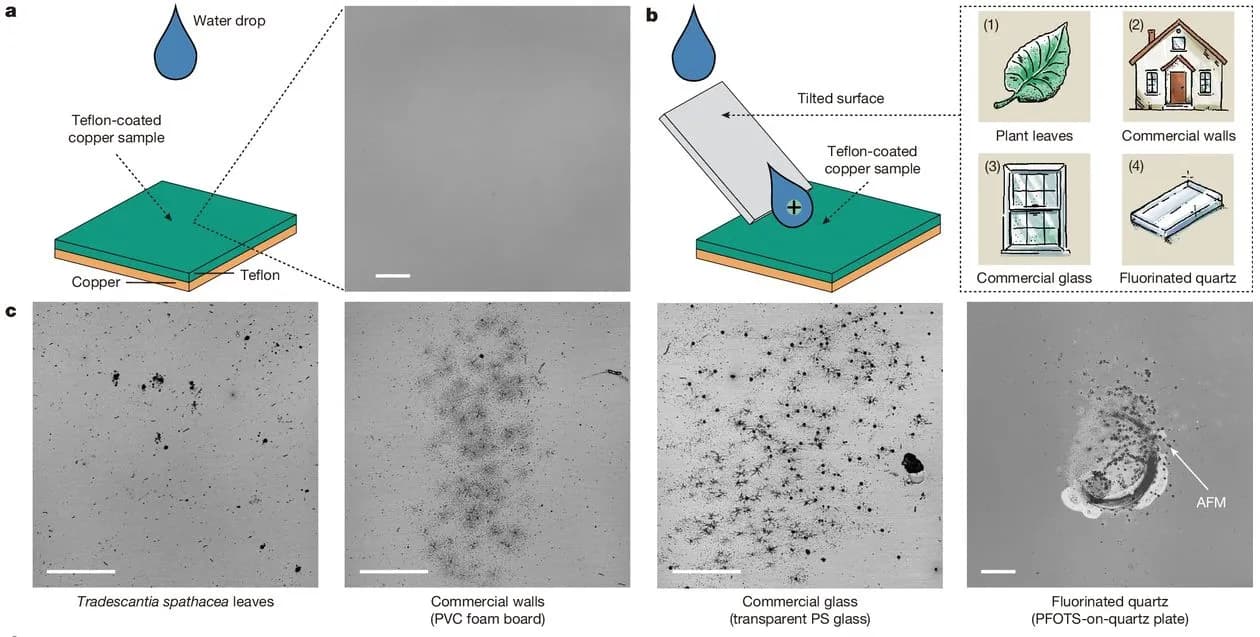
Raindrops carry enough electric charge to corrode metal through protective coatings. A study by Zhongyuan Ni et al., published in Nature, measured water droplets building over 1 kV of electric potential as they slide across insulating surfaces. That charge is sufficient to cause dielectric breakdown of coatings, with the droplet acting as one electrode and the grounded metal surface acting as another.
The team demonstrated this by routing droplets across an insulating surface before hitting a Teflon-coated metal target. The water contained dissolved sodium chloride to simulate real rainfall. The coating failed progressively, exposing bare metal beneath. The mechanism is confirmed, not theorized: post-experiment sample analysis matched the dielectric breakdown model. The detail worth reading is exactly how the charge accumulates and transfers across the coating interface.
There is no clean fix. Pre-discharge systems are possible but not straightforward to deploy. The paper notes that charged droplets also form in clouds, ocean waves, and a broad range of industrial processes, making this a systemic materials problem, not a niche lab result. Anyone designing protective coatings for outdoor or industrial environments should read the full study.
[READ ORIGINAL →]