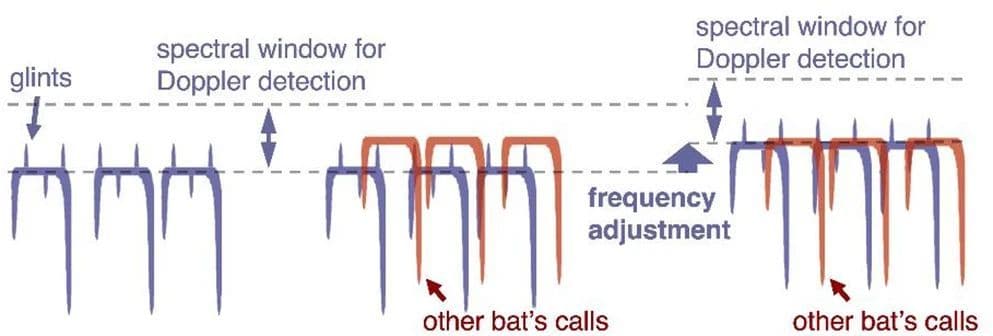
Greater Japanese horseshoe bats actively shift their echolocation frequencies to match their colony neighbors, preventing acoustic interference that would otherwise blind them. Haruhito Matsumoto et al., publishing in Journal of Comparative Physiology, documented this behavior by mixing wild-caught and resident bats and measuring adjustments to the dominant second harmonic constant-frequency component, CF2.
The mechanism matters because CF echolocation encodes Doppler shift data, giving bats precise velocity and position information. That precision collapses in a dense colony if every bat is transmitting at a different frequency. The solution the bats use is frequency convergence toward a shared 'silent spectral window' positioned above the CF2 frequency. Bats operating below that window shift upward to reach it. The paper traces exactly how that adjustment plays out between wild-caught individuals and established residents.
Read the full paper for the frequency measurements and the experimental setup, which is where the real signal-to-noise story lives. The broader implication, that biological sonar systems solve interference problems through dynamic frequency coordination rather than separation, has obvious relevance for engineered arrays and dense RF environments.
[READ ORIGINAL →]