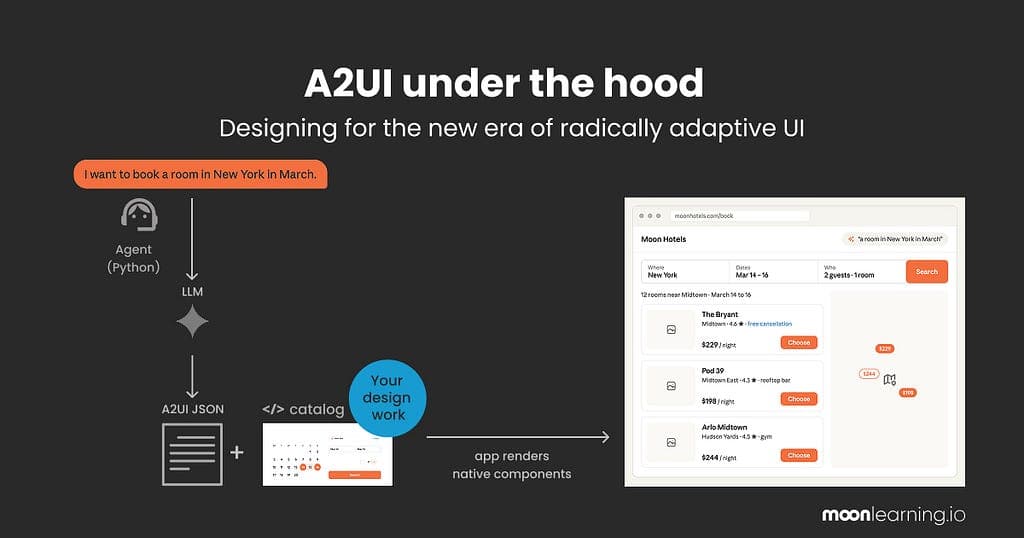
A2UI is a protocol, not a product. Started by Google, now shaped alongside CopilotKit and related specs like A2A and AG-UI, it defines a shared language between an AI agent and a front-end renderer. The agent receives a user request, bundles it with a component catalog, passes it to an LLM like Gemini, and gets back a JSONL stream describing exactly which components to assemble and how. The renderer builds the screen from that recipe, using only components that already exist in your design system. Nothing generic. Nothing improvised.
This matters for designers for one specific reason: the system can only call components a designer built first. Clean code, handled edge cases, accessibility included. The imagined average user persona, the one designers have constructed and designed for since the beginning of the discipline, stops being the target. The actual request, from the actual person, in the actual moment, becomes the interface. Competitors to A2UI already exist, including json-render by Vercel and MCP-UI, which tells you how fast this space is moving.
The spec is young, most implementations are still demos, and no solid design-to-code pipeline exists yet. Developers are currently making the decisions. The full article walks through the A2UI flow step by step with designer-readable diagrams, a working demo from Southleft, and a concrete hotel booking example that shows the gap between today's fixed-page experience and what adaptive UI actually delivers. Read it before your next design system conversation.
[READ ORIGINAL →]