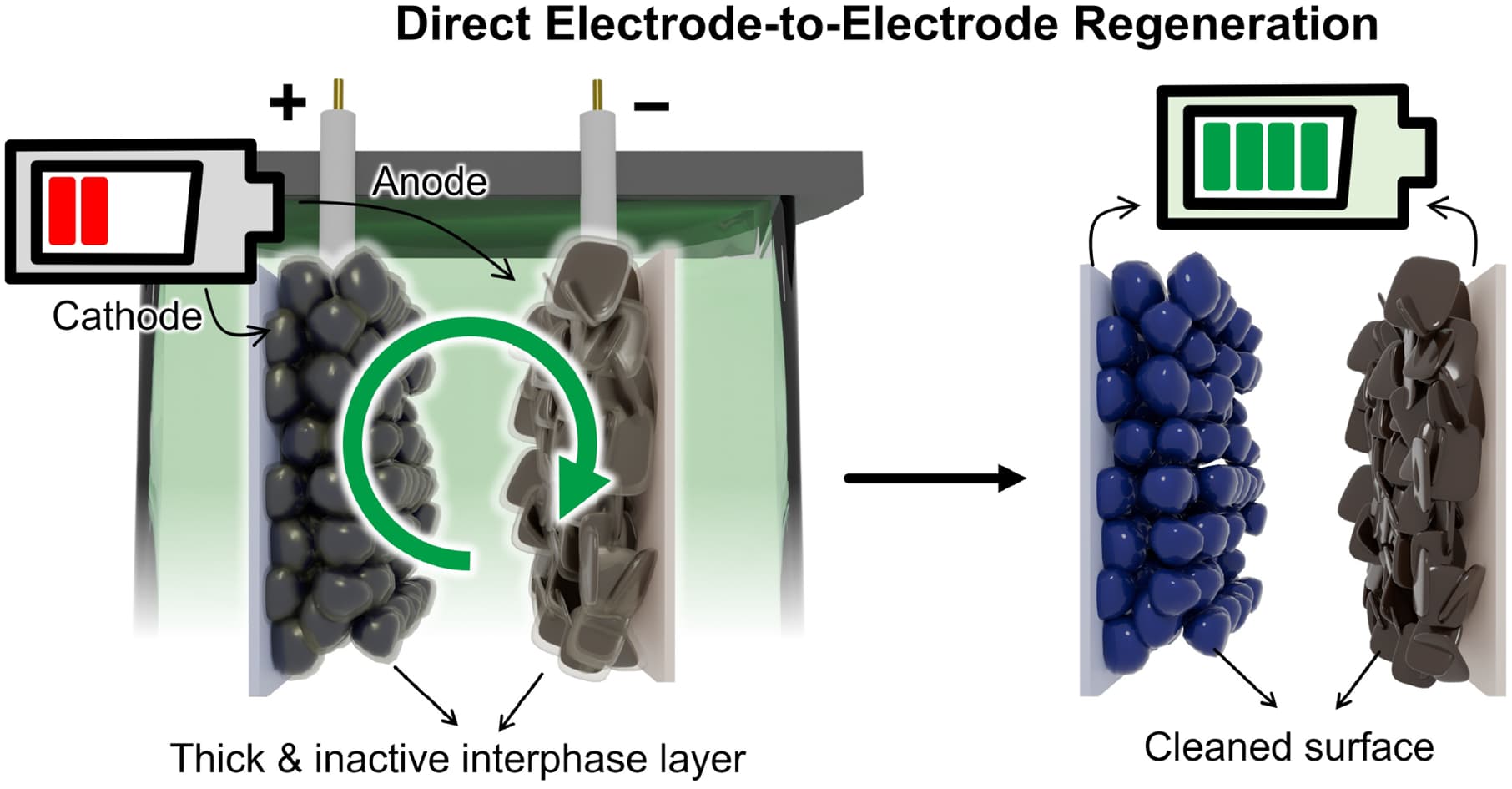
Cornell researchers have developed a lithium battery recycling method that restores up to 95% of original cell capacity while cutting recycling costs by more than half. The process, called Direct Electrode-to-Electrode Regeneration (DEER), skips the grinding and chemical breakdown that defines most current recycling pipelines.
The core insight is electrochemical, not mechanical. Degraded lithium cells fail largely because thick, inactive interphase layers accumulate on the electrodes over charge cycles. DEER dissolves those layers using 1,3-dimethyl-2-imidazolidinone (DMI) as a solvent, cleans the electrodes in place, and reassembles the cell without reducing the active material to raw feedstock. That distinction is what makes the cost reduction credible, not incremental process tuning.
The paper, published in Energy and Environmental Science, is worth reading in full for its electrochemical characterization data and the cost modeling behind the 50%-plus reduction claim. With lithium prices falling and recycling economics tightening, a method that sidesteps full material breakdown has real commercial stakes.
[READ ORIGINAL →]