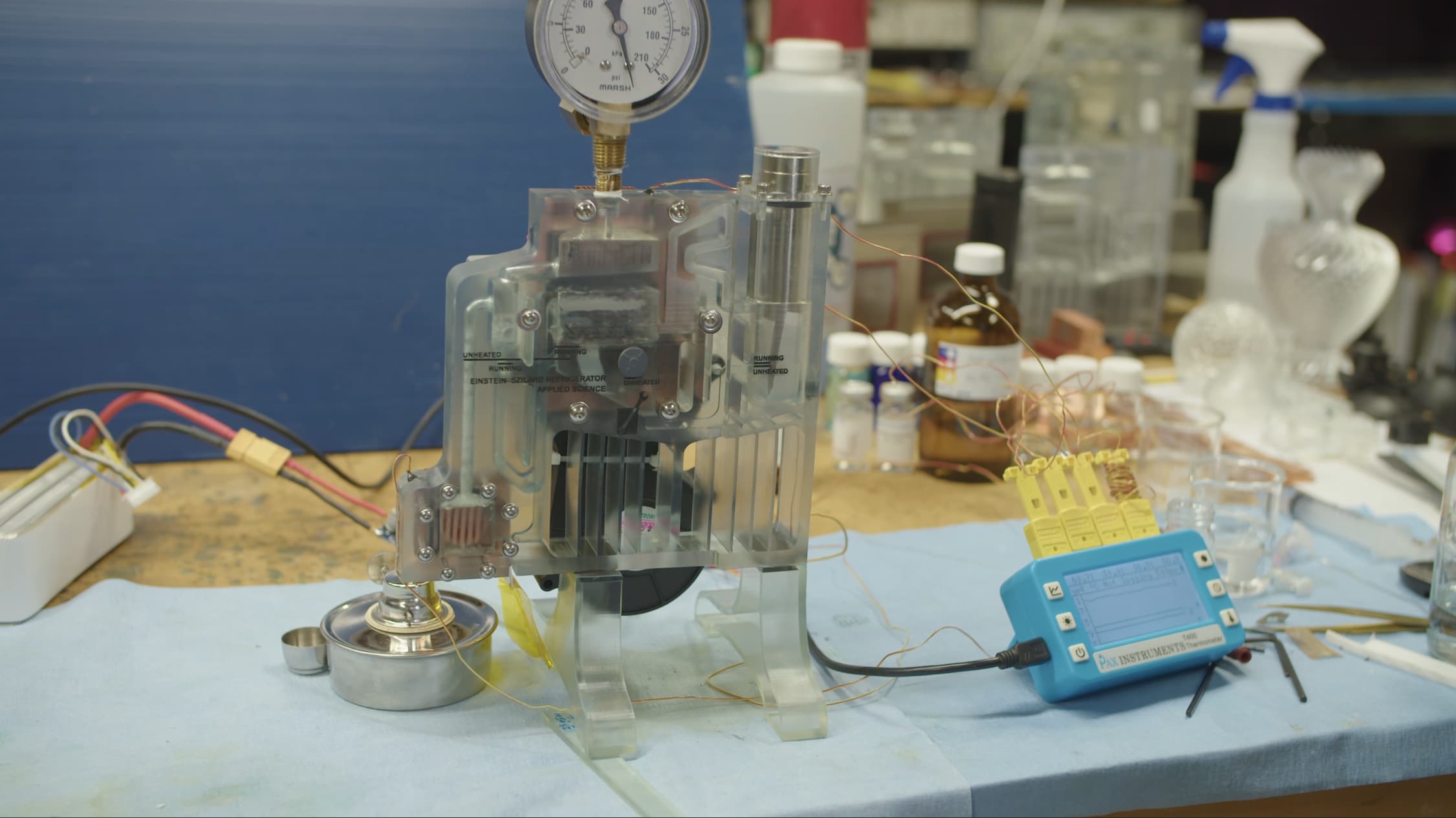
Ben Krasnow built a transparent, 3D-printed Einstein-Szilard absorption refrigerator powered by an open flame, and got it to cool 5 degrees Celsius below ambient temperature. The body is clear resin, the heat transfer block is copper, and the working fluids are ammonia, water, and perfluoropentane, a nonflammable substitute for the more typical butane refrigerant.
The Einstein-Szilard design is worth understanding on its own terms. Unlike standard absorption fridges that require pressures too high for plastic or glass enclosures, this three-fluid design operates at lower, manageable pressures with no moving parts. Ammonia gas lowers the partial pressure of the refrigerant, causing it to evaporate and produce cold, then both gases dissolve back into water and the cycle restarts. The single internal flow path is the engineering problem: one misplaced bubble airlocks the whole system, and ammonia dissolves copper, so the heat transfer block is already on borrowed time.
Read the full piece for Krasnow's troubleshooting of the airlock problem and his note that high-concentration alcohol could theoretically cool your drink by burning part of it. The video walkthrough makes the thermodynamic cycle legible in a way that diagrams rarely do.
[READ ORIGINAL →]