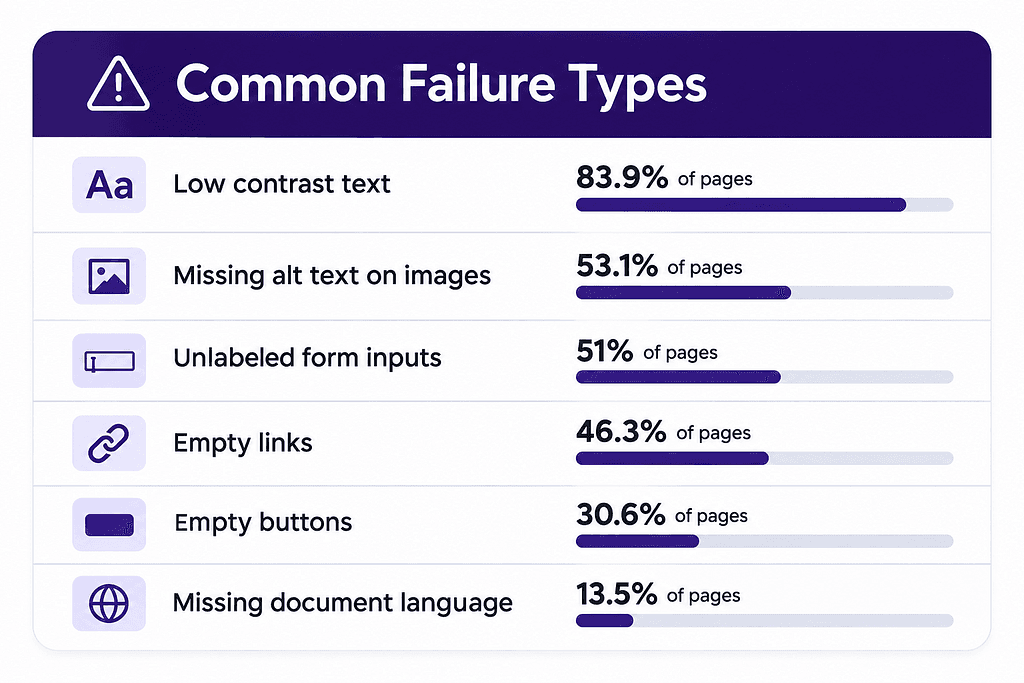
The web got less accessible in 2026. WebAIM's annual crawl of one million home pages found errors on 95.9% of them, averaging 56 barriers per page. That number reversed six consecutive years of slow progress. The six most common failures: low contrast text on 83.9% of pages, missing alt text on 53.1%, unlabeled form inputs on 51%, empty links on 46.3%, empty buttons on 30.6%, and missing document language on 13.5%. Those same six failures have topped the list for seven straight years.
The article's core argument is worth reading in full because it reframes the problem entirely. WCAG and Section 508 are not a separate discipline bolted onto design. They are legal and technical translations of principles any trained designer already learned before they ever heard the acronyms. Visual hierarchy maps to WCAG 1.3.1 and 2.4.6. Contrast maps to 1.4.3. Meaningful labels map to 3.3.2. The failure is not ignorance of standards. It is a vocabulary gap. Pages using ARIA averaged 59.1 errors versus 42 on pages without it, which tells you that developers are reaching for complex solutions while basic structural semantics remain broken.
What makes this worth a full read is the 10-point mapping the author builds between named design principles and their specific WCAG criteria, with failure rates attached to each. It turns an abstract compliance checklist into a diagnostic tool. If 41.8% of pages skip heading levels and 18.1% have more than one h1, that is not an accessibility failure. That is a visual hierarchy failure that never made it into the underlying structure. The argument is that once designers see the 1:1 correspondence, the standards stop feeling external. They start feeling like accountability for work they were already supposed to be doing.
[READ ORIGINAL →]