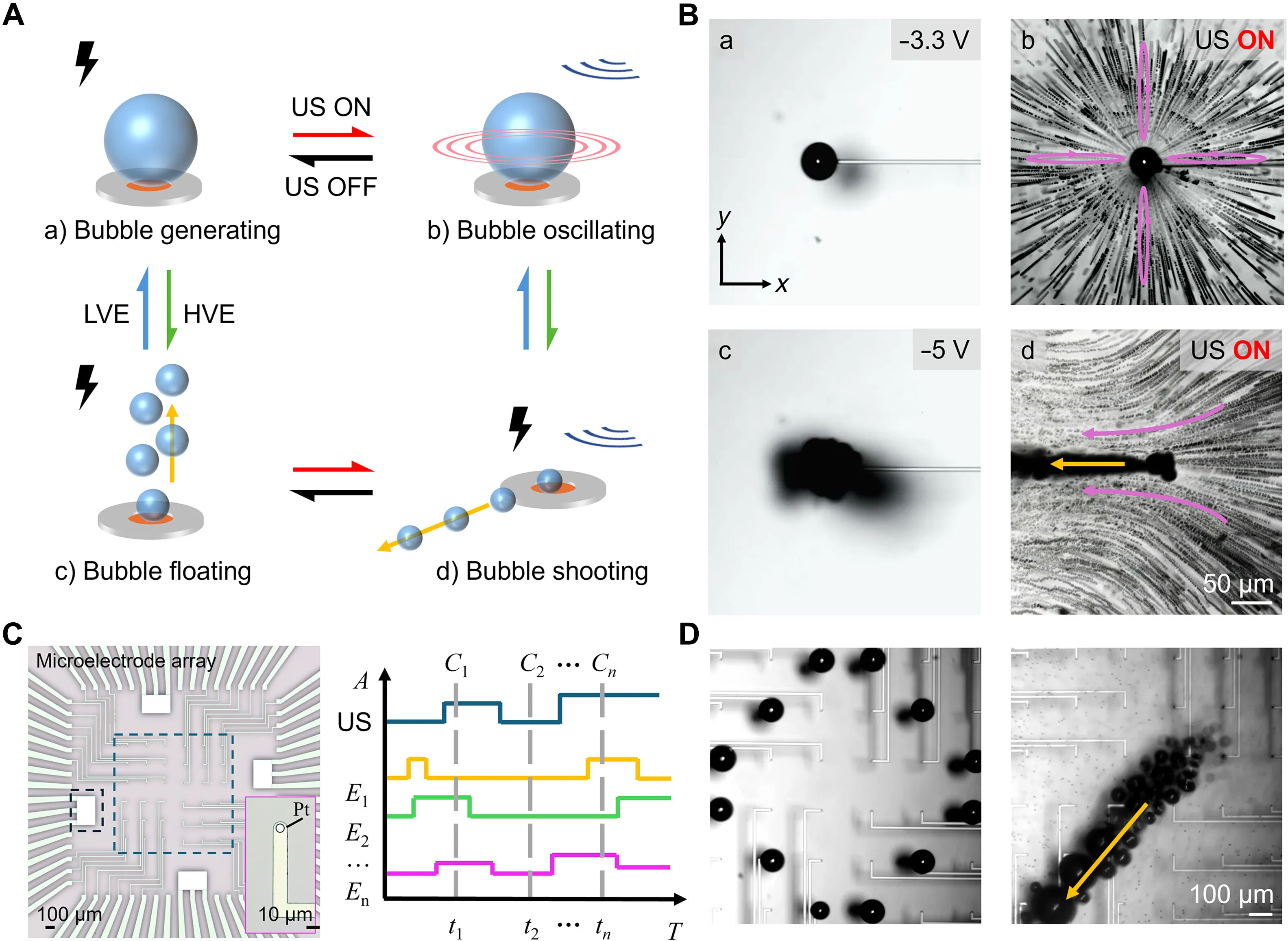
Researchers at Cornell have built a chip-scale device that generates hydrogen microbubbles along a grid of electrodes and steers them using ultrasound, with the work published by Zhiyuan Zhang et al. in Science Advances. The key mechanism: each bubble size in the 10 to 100 micron range has its own resonant frequency, so varying the ultrasound frequency gives individual control over specific bubbles without touching the others.
The physics here is what makes the full paper worth reading. The team is not just moving bubbles around. They are using electronically programmable bubble formation combined with acoustic resonance matching to build a platform capable of driving actuators and manipulating acoustic systems dynamically. That combination, formation control plus frequency-selective steering, is the problem the field has not cleanly solved before.
The current 2D implementation still depends on a bulky benchtop ultrasound rig, and chamber geometry meaningfully changes bubble behavior, a problem that gets harder fast in 3D enclosures. Whether this shrinks into something practical depends on solving both. The paper lays the groundwork; the engineering gaps are still wide open.
[READ ORIGINAL →]