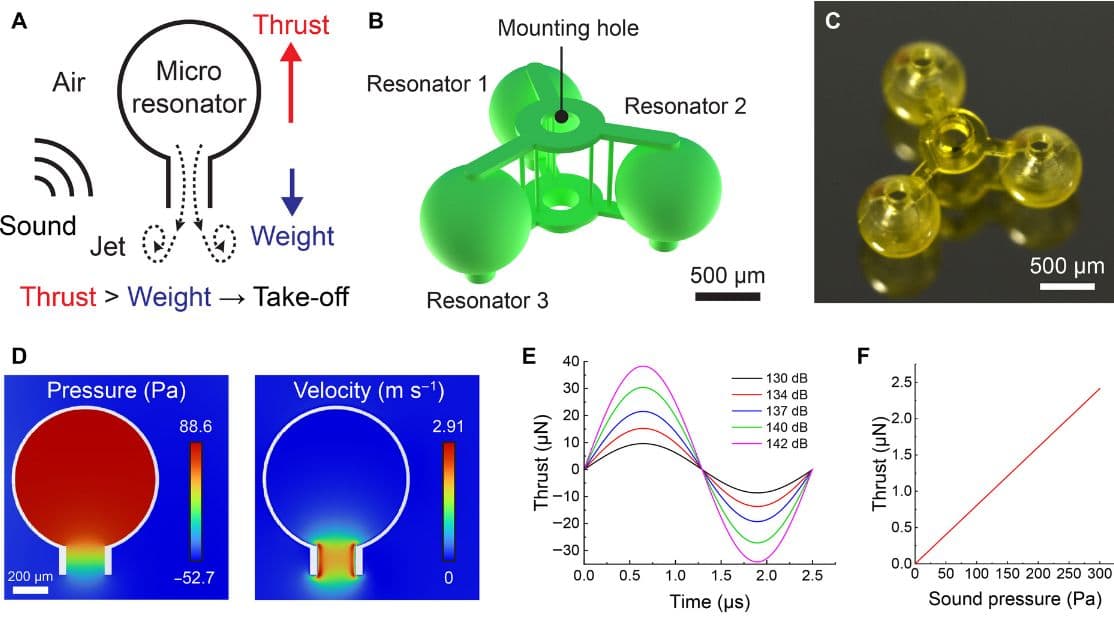
Researchers at EPFL have built flying and floating microrobots propelled entirely by sound, using Helmholtz resonance as the thrust mechanism. The paper, published in Science Advances by Junsun Hwang et al., shows that an acoustic chamber stimulated at its resonant frequency ejects a jet of air from its neck. That jet is the thruster.
The team built two demonstrators. A boat uses three resonance chambers for propulsion and steering, with ultrasonic transducers mounted directly to the chamber floors. The microflier, weighing in the order of micrograms and fabricated via high-resolution 3D printing, hovers above an ultrasonic phased array without carrying any transducers at all. A second microflier variant angles the resonator chambers to spin a propeller. Thrust is a fraction of a Newton, which is why mass is the central engineering constraint throughout.
The external-transducer dependency makes these robots impractical outside controlled lab conditions for now. That is not the point. The paper is worth reading for the detail on chamber geometry optimization, the iteration process on 3D-printed resonator configurations, and the steering mechanics of the acoustic boat. The core question it raises: how far can acoustic actuation scale if weight keeps dropping.
[READ ORIGINAL →]