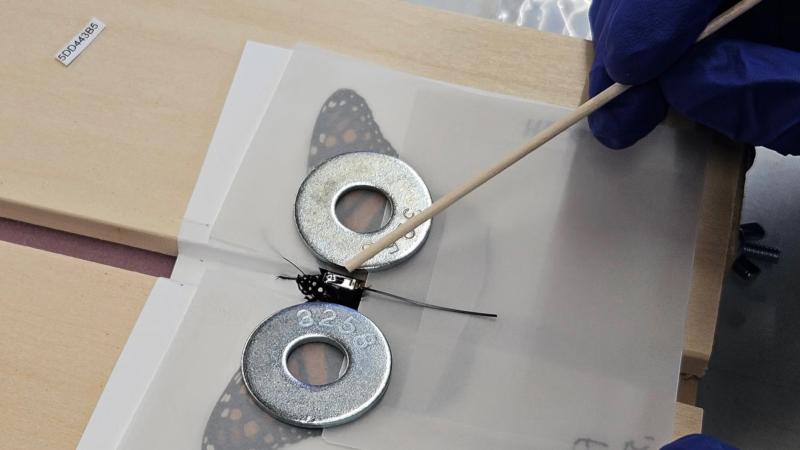
A 60-milligram solar-powered Bluetooth transmitter called BlūMorpho now rides on monarch butterflies to map their migration. No battery. The device is shaped like a tadpole and draws enough power from a small solar cell to emit a Bluetooth signal that any nearby smartphone can pick up and relay as a location ping.
The science case is specific: most monarchs live 2 to 6 weeks, but a periodic 'super generation' survives up to 9 months, long enough to complete the full Canada-to-Mexico migration and return. Researchers needed data on that cycle. BlūMorpho fills the gap. Attachment uses a glassine envelope, minor wing ballast, and eyelash glue. A public app at projectmonarch.org lets anyone participate in the tracking network.
The hardware question worth reading for: what is the actual ceiling for a passive, crowd-sourced Bluetooth tracking network? Dedicated ground stations, as covered in a related October 2026 piece on pushing Bluetooth to 12 kilometers, suggest the architecture scales further than a phone-dependent mesh. The full article and attachment demonstration video lay out both the biology and the engineering constraints.
[READ ORIGINAL →]