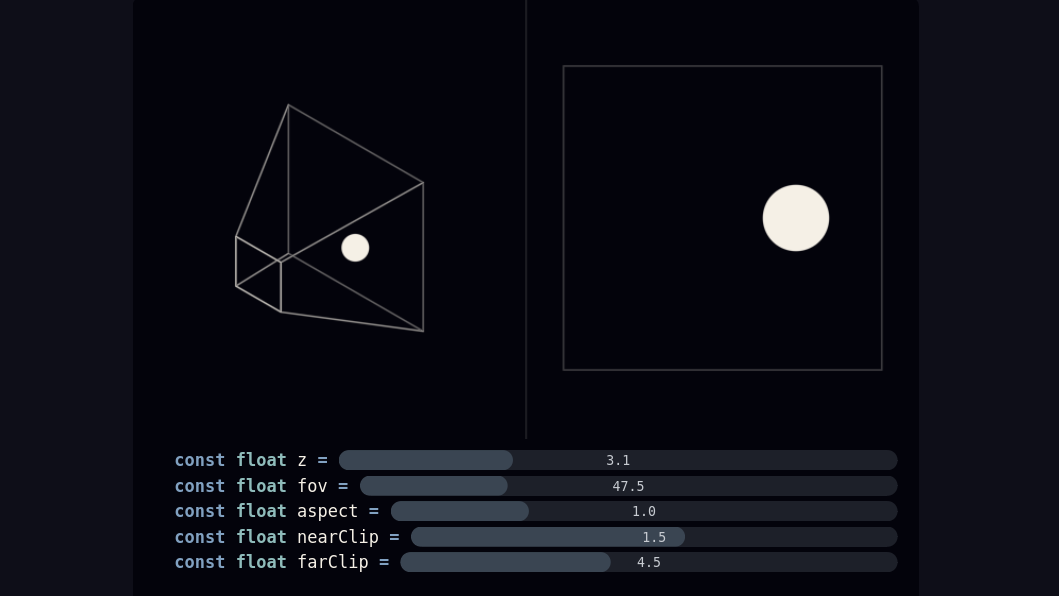
Dividing X and Y by Z is the entire secret behind 3D perspective rendering. Developer Gabriel breaks down the perspective projection matrix into five concrete inputs: near and far clipping planes, aspect ratio, field of view, and camera position. That single division operation is what makes distant objects shrink and the illusion of depth hold together.
Gabriel built this explainer after hitting the ceiling of high-level graphics frameworks and needing to understand what the camera abstraction was actually doing underneath. The answer is a trapezoidal frustum, a truncated pyramid volume representing everything the camera sees, encoded as matrix math. The article walks through each variable with live sliders so you can watch the projection warp in real time as you move the clipping planes or change the FOV.
The reason to read the full piece is not just the conclusion. It is the interactive diagrams that make the matrix intuitive rather than abstract. If you have ever shipped something using Unity, Three.js, or any scene graph and never looked at the projection matrix directly, this is the gap in your knowledge Gabriel is filling in about 1,500 words and a handful of WebGL demos.
[READ ORIGINAL →]