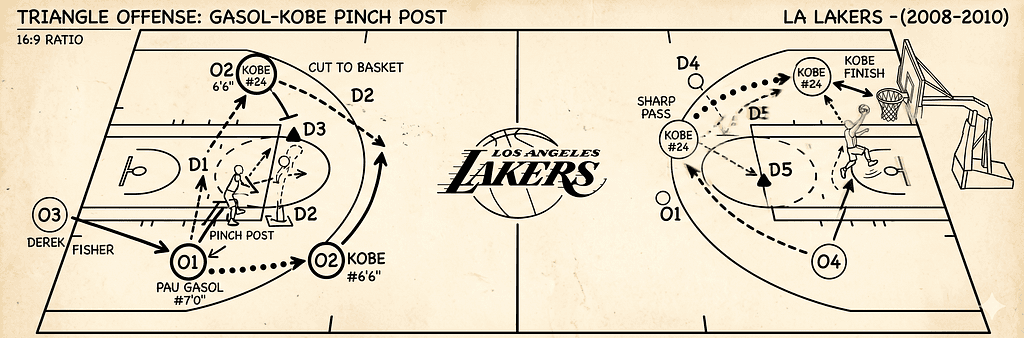
Basketball coaches solved your coordination problem decades ago. Pat Riley's laminated binder, Gregg Popovich's five championships with five different rosters, Phil Jackson's triangle offense, Dawn Staley's player-centered culture, Steve Kerr's hybrid synthesis: each one maps directly onto a software methodology your team has already argued about in a retro. The article's core claim is blunt: waterfall, agile, and systems thinking were not invented by consultants. They were stress-tested in public, on scoreboards, for over a hundred years.
The methodology breakdown is specific and worth reading in full. Riley's 'Riles Rules' binder was a literal software specification, and the Detroit Pistons exploited it the same way a competitor exploits a rigid technical architecture. Popovich's Spurs onboarded European players into a complex system within a single season, which the article compares directly to a CLAUDE.md file that actually works. Jackson's triangle required players to read the defense and make decisions autonomously, the same cognitive load now being redistributed to AI agents. Staley's South Carolina program demonstrates that psychological safety is not a soft metric, it is a performance variable with a championship record.
The AI urgency is the real argument. When a prototype that took three weeks now takes three hours, the economic justification for upfront specification collapses. The article is not a nostalgia piece about basketball. It is a framework selection guide for teams currently deciding how much autonomy to give AI agents, how to structure human oversight, and what kind of culture survives the transition. The Kerr section, where all four coaching philosophies converge, is where the engineering implications get concrete.
[READ ORIGINAL →]