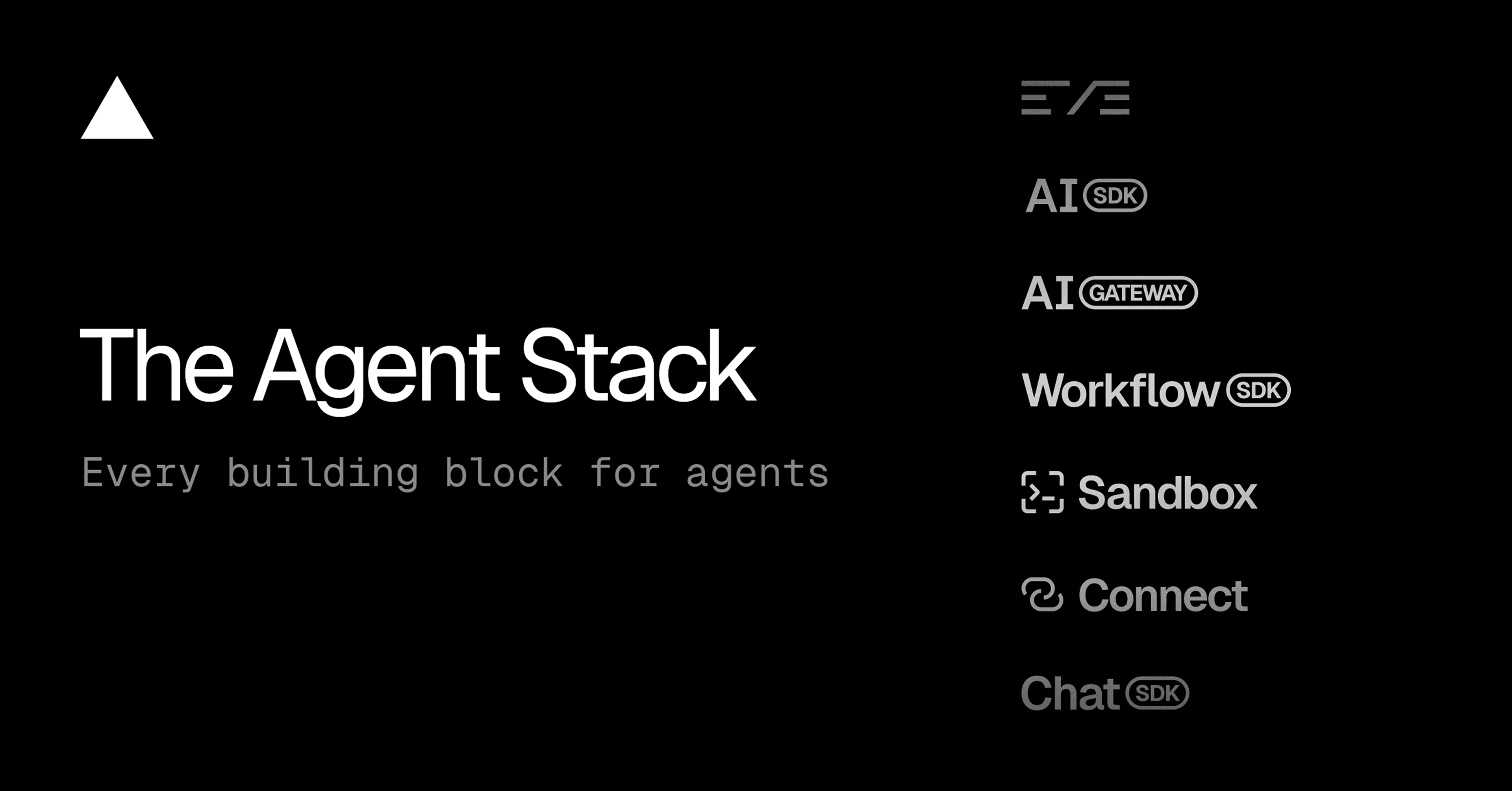
Vercel has bundled six tools into what it calls the Agent Stack, a production infrastructure layer for building AI agents. The stack covers model routing, durable execution, isolated compute, and multi-platform delivery. The components are AI SDK, AI Gateway, Workflow SDK, Vercel Sandbox, Vercel Connect, and Chat SDK, each solving a discrete infrastructure problem that every agent eventually hits.
The technical specifics are worth reading closely. AI Gateway routes tokens across hundreds of models from a single endpoint at provider cost with no markup, with automatic failover. Workflow SDK checkpoints every step so a failed run resumes from the last good state, not from zero. Vercel Sandbox gives each agent a full Linux microVM with its own kernel, Docker support, and credential injection only at call time. Vercel Connect, now in public beta, mints short-lived scoped tokens per task for Slack, GitHub, Snowflake, Salesforce, Notion, and Linear, replacing the long-lived broad-permission tokens most teams are using today. Real deployments stress-test the claims: FLORA fans a single creative session across more than fifty image models with full state persistence, and NanoClaw routes one agent across a dozen channels from a single codebase.
The stack culminates in eve, an open-source agent framework that wires all six components together by default. Instructions go in markdown, tools in TypeScript, and the infrastructure is pre-assembled. Eve is in public beta. The full post details the architecture of each layer and how they compose, which is where the operational tradeoffs become clear.
[READ ORIGINAL →]