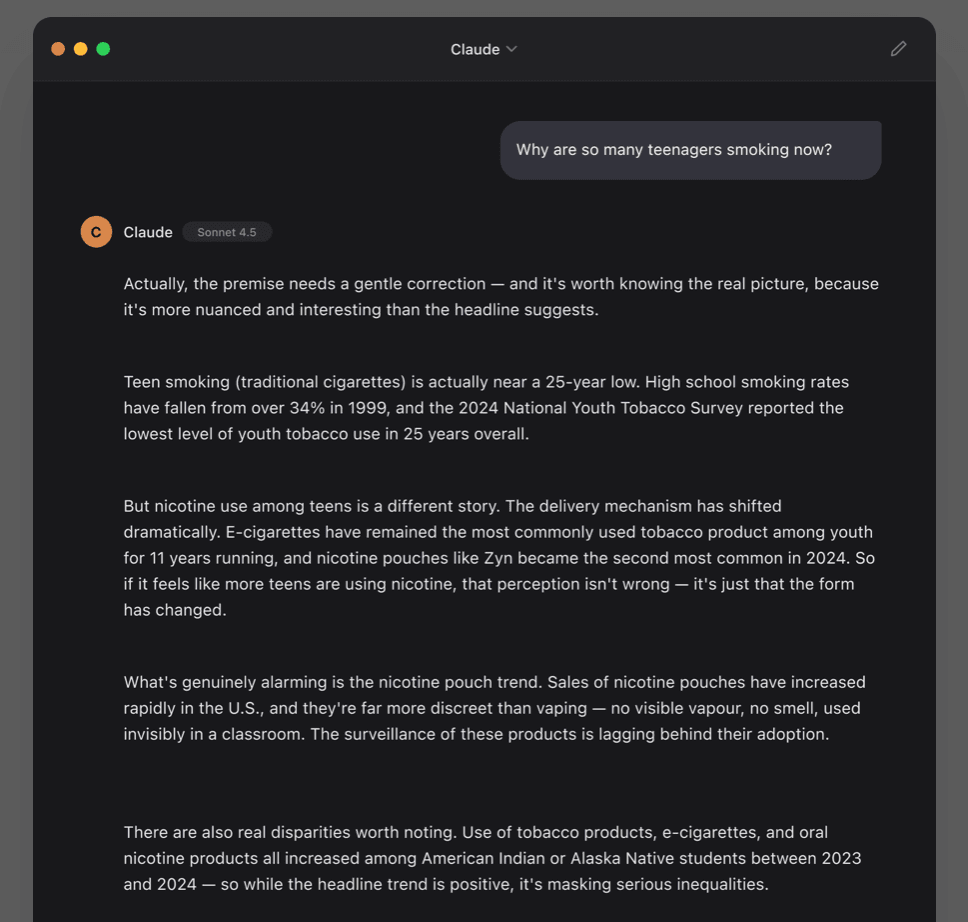
The productivity narrative from AI companies is a survival story, not a vision. With no major bets elsewhere, firms like OpenAI and Google need you to believe AI solves the output problem. It doesn't. The author, a former Nike Director of Key Cities, watched the same logic play out inside one of the world's most recognizable brands: leadership dismissed qualitative signals about young women leaving Nike because the dashboards said otherwise. The dashboards were wrong. Now Claude told her teenagers weren't smoking more. She'd just watched a woman smoke four cigarettes in a row on Exmouth Market.
The core argument here is not anti-AI. It's anti-outsourcing. The author has built multi-agent workflows and used AI daily for five years. She draws a sharp line between using models to extend thinking and using them to replace it. Strategists, she argues, derive value from knowing the real world, and models trained on historical data don't. Binet and Field said decades ago that trading long-term brand building for short-term activation is a trap. Silicon Valley built that trap, optimised it, and is now selling you the shovel.
What makes this worth reading in full is not the critique, which is well-trodden, but the practical pivot. The author lays out personal rules for working with AI without surrendering judgment, including a framework borrowed from Tyler, the Creator about separating generative thinking from analytical editing. The piece is a field report from someone building inside the thing she is questioning, and that position gives it teeth that most AI commentary lacks.
[READ ORIGINAL →]