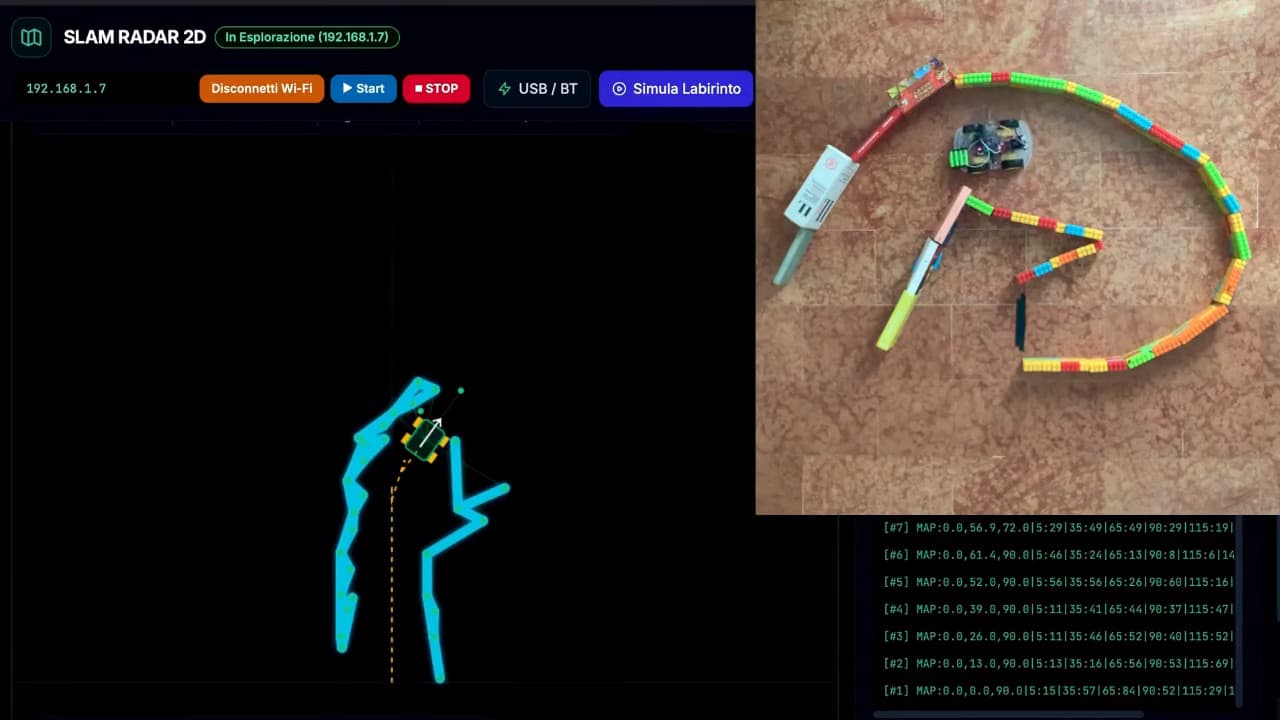
Luca Fagioli built a four-wheel-drive robot that performs Simultaneous Localization and Mapping using an Arduino Uno R4 Wi-Fi, not a $200 RealSense camera or a laser rangefinder. The sensor doing the heavy lifting is an HC-SR04 ultrasonic module mounted on an SG90 servo, which pans to sweep the environment and feed range data into the SLAM algorithm in real time.
The full hardware stack is a small plastic chassis with one gear motor per wheel, a Sensor Shield 5.0, and an L298N motor driver. Infrared sensors on the underside read tape marks on the floor as checkpoints for localization. The result is a self-mapping robot built from parts that cost less than a textbook on robotics.
The reason to read the full project on Hackaday.io is not the conclusion. It is the implementation detail: how a microcontroller with modest compute handles SLAM without offloading to a host machine, and how checkpoint-based localization compensates for the inherent noise of ultrasonic ranging. That tradeoff is where the real engineering lives.
[READ ORIGINAL →]