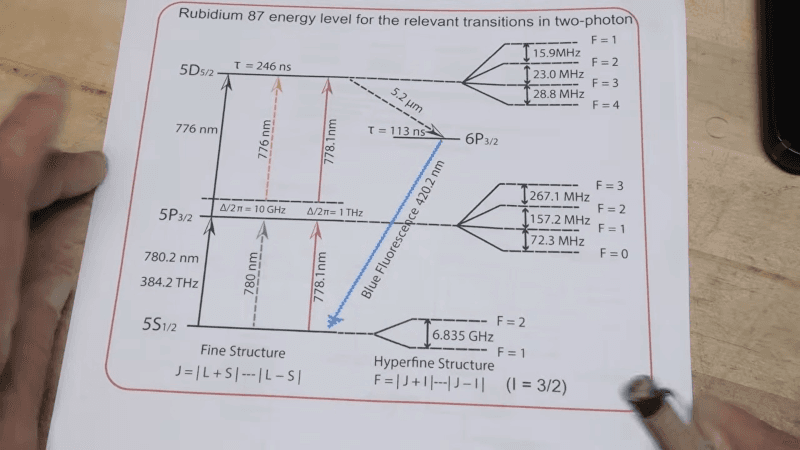
Rubidium frequency standards lock a microwave oscillator to a 6.835 GHz atomic transition in rubidium-87, producing a frequency reference far more stable than any quartz crystal. The IMSAI Guy's explainer video breaks down exactly how three gas cells, a discharge lamp, and a feedback servo combine to make this work.
The mechanism is specific: an RF-excited rubidium-87 lamp emits light at precise wavelengths, a rubidium-85 filter cell strips away the unwanted spectrum, and the remaining light optically pumps atoms in a resonance cell into one of two hyperfine ground states split by electron-nucleus magnetic interaction. When a local oscillator hits exactly 6.835 GHz, it drives transitions between those states, producing a detectable dip in transmitted light at a photodetector. Electronics servo the oscillator onto that dip, analogous to a phase-locked loop but anchored to physics, not geometry.
The video is worth watching in full for how it builds from rubidium's position on the periodic table through isotope physics to the complete servo loop. Rubidium sits below cesium in accuracy, and optical clocks beat both, but rubidium standards remain the practical workhorse for portable, affordable precision timing. Understanding why requires understanding the tradeoffs the video actually explains.
[READ ORIGINAL →]