OpenAI and Anthropic are each running at roughly $30B annual revenue, which is 0.1% of US GDP apiece. Add cloud and adjacent AI services and the sector has grown from near zero to 0.25-0.5% of GDP in a few years. If both labs hit $100B by end of 2025, AI will represent close to 1% of GDP run rate by end of 2026. The piece raises a harder question underneath that number: how much of AI's productivity impact will go unmeasured, the way IT gains were invisible in GDP figures through the 1980s and 1990s, and whether that mismeasurement will drive bad regulatory responses that punish only the visible costs.
Meta's aggressive talent bidding triggered what the author calls a distributed IPO across AI labs. Somewhere between 50 and a few hundred researchers at the major labs were handed life-changing compensation packages simultaneously, not through a single company listing but through a cross-industry salary war. The behavioral consequences mirror what happens post-IPO: a subset checks out, buys real estate, gets distracted. The analogy the author reaches for is early crypto HODLers going post-economic all at once. Meanwhile, memory supply constraints from Hynix, Samsung, and Micron are creating a compute ceiling that may hold until at least 2028, effectively enforcing an oligopoly on frontier model development and extending the depreciation cycles on existing silicon well beyond original projections.
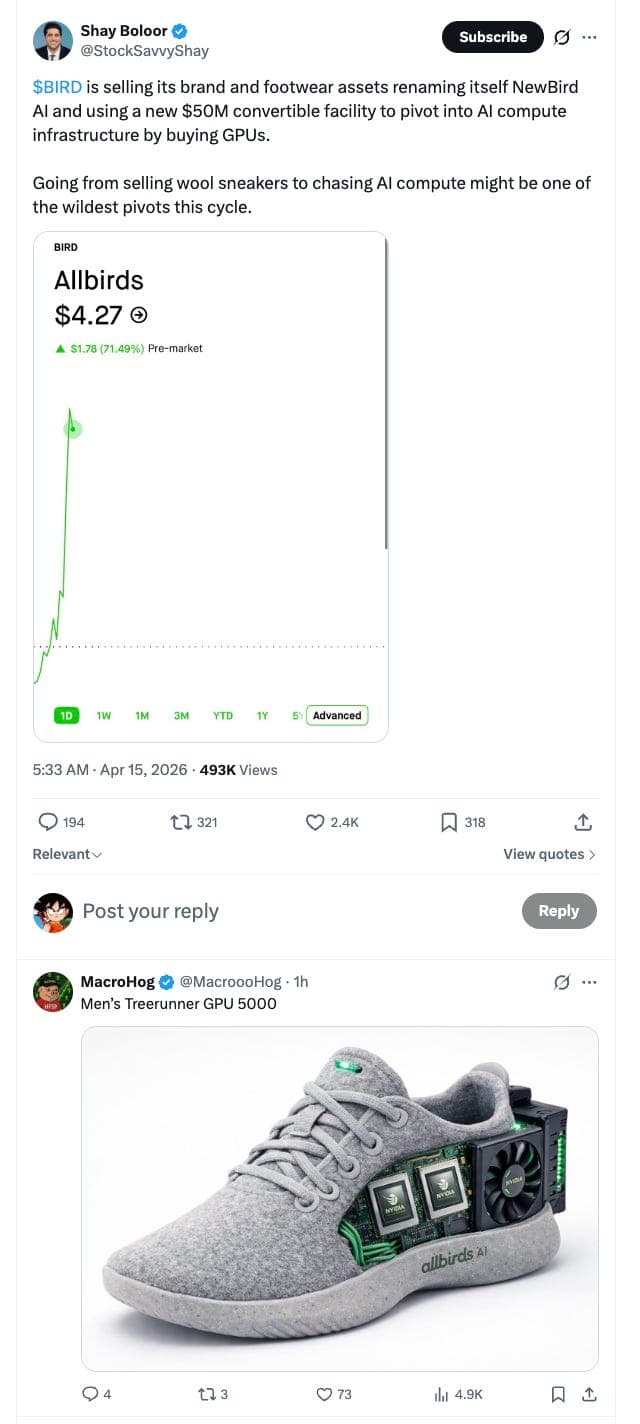
The original piece is worth reading in full because it does not stop at observations. It traces the structural consequences: labs accordion-ing compute between model training and application development, tools like Cursor subsidizing inference as a user acquisition strategy, and Allbirds, a shoe company, raising a convertible note to build a GPU farm. The question of whether a single algorithmic breakthrough, if kept internal rather than leaked at an SF party, could shatter the compute-constrained oligopoly before 2028 is left open and genuinely unresolved. That unresolved tension is the reason to read it.
[READ ORIGINAL →]