Broadcom CEO Hock Tan fired roughly 19,000 VMware employees after a $61 billion acquisition, sold 13 of 18 campus buildings, removed the espresso machines, and told staff asking about childcare benefits: 'I'm not your dad.' The company just signed a $30 billion chip deal with Apple and holds dominant positions in custom AI silicon, including Google's TPUs. Its stock ticker is AVGO because 'Broadcom' is actually Avago Technologies, a private equity spinoff from Hewlett Packard that absorbed the original Broadcom in 2016.
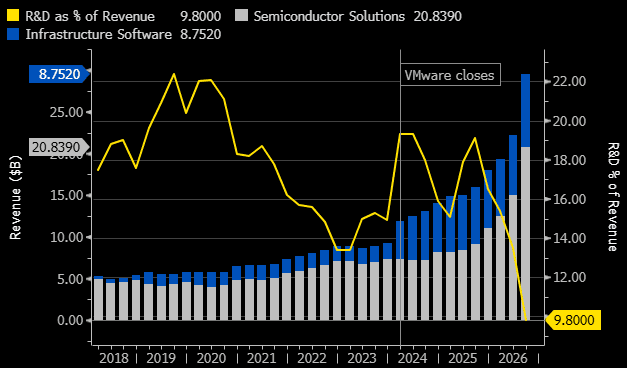
The R&D numbers tell the real story. During Tan's dozen years as CEO, Broadcom spent six times more on acquisitions than on R&D. That ratio was already alarming enough for CFIUS and the Trump administration to block Broadcom's $117 billion bid for Qualcomm in 2018, citing risk to next-generation wireless development. Since absorbing VMware, Broadcom's R&D spend has collapsed further to 9.8% of revenue, making it one of the lowest among major semiconductor peers, trailing only NVIDIA, which earns that position from a different direction entirely.
The full piece traces Broadcom's full corporate genealogy, from HP spinoff to acquisition machine, and builds the case that its AI chip dominance is built on the same model as Oracle: buy, gut, and extract. The argument is sharpest in the R&D data and the Qualcomm episode, where a dozen banks arranged a $100 billion bridge loan for a deal that regulators killed specifically because they feared what Tan would do to American innovation. Read it to understand how much of the AI infrastructure boom is sitting on a foundation of deliberate underinvestment.
[READ ORIGINAL →]