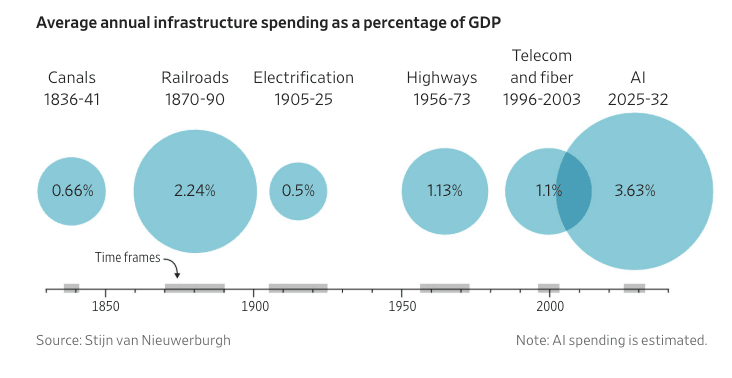
Goldman Sachs projects AI investment will hit 1.9% of U.S. GDP in 2026, the largest single-industry share since the railroad boom of the late 19th century. But that number is almost entirely driven by data center construction and GPU hardware sales, not by companies actually buying AI compute or software. The WSJ and Brookings framed this as an AI economy story. It is an infrastructure spending story.
The BEA's ICT industry data, which directly tracks AI software sales and GPU rental revenue, shows tech's nominal GDP contribution has been flat for two years. The 'real GDP' case fares no better: the BLS Producer Price Index for software publishers currently sits lower than it did in 1997, a figure the author argues is structurally broken. SaaS prices have risen more than nine percentage points above consumer inflation every single month of 2025, yet the BLS quality-adjustment methodology treats those increases as customers receiving better software, not paying more for the same thing. The result: the BEA may be accidentally overstating tech's GDP contribution, and AI token-based pricing makes the distortion worse.
The article is worth reading in full for two reasons. First, it traces exactly how Apple's iCloud revenue, NVIDIA's GPU sales, and Accenture's consulting fees each land in different BEA industry buckets, clarifying why aggregate 'tech' numbers mislead. Second, it builds toward a calculation of ICT gross value added against real GDP that challenges the dominant narrative of AI-driven economic growth. The data center buildout will slow. When it does, AI services revenue must fill the gap. So far, the BEA data suggests it is not close.
[READ ORIGINAL →]