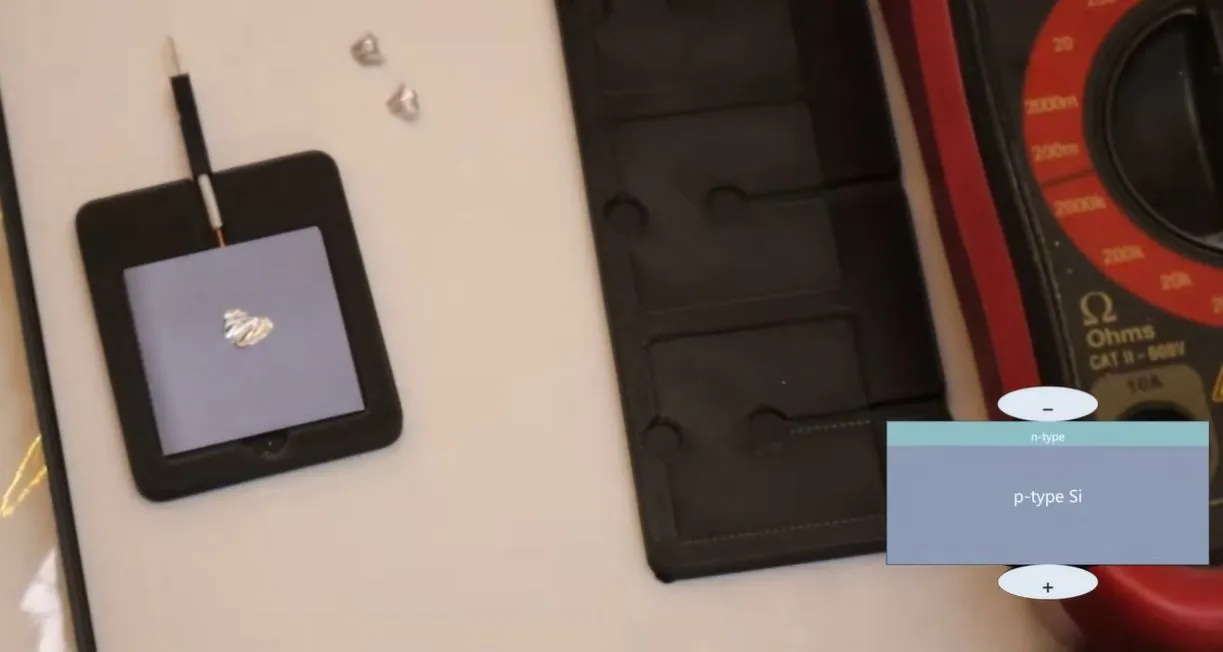
Dr. Semiconductor built a working photovoltaic solar cell at home using a microwave kiln, a bare silicon wafer, and a spin-coating solution of tetraethyl orthosilicate, phosphoric acid, ethanol, and distilled water. The cell achieves 5% efficiency. That number is low by commercial standards, but the point is that it works.
The process is specific and replicable. The coating solution is mixed in precise ratios, boiled for 30 minutes, then spin-coated onto a silicon wafer using a PC fan as a makeshift spinner. The coated wafer bakes in the microwave kiln at under 50% power for half an hour to diffuse phosphorus into the silicon and form the n-type junction. Contacts are gallium-indium on the p-type side and indium on the doped side.
The full recipe is documented on semiconductor.diy, but the video is worth watching for the failure modes and practical workarounds Dr. Semiconductor works through in real time. Efficiency gains are possible with an anti-reflection coating, cleaner handling, and better contact geometry. This is a proof of concept, not a finished product, and that distinction is exactly what makes it interesting.
[READ ORIGINAL →]