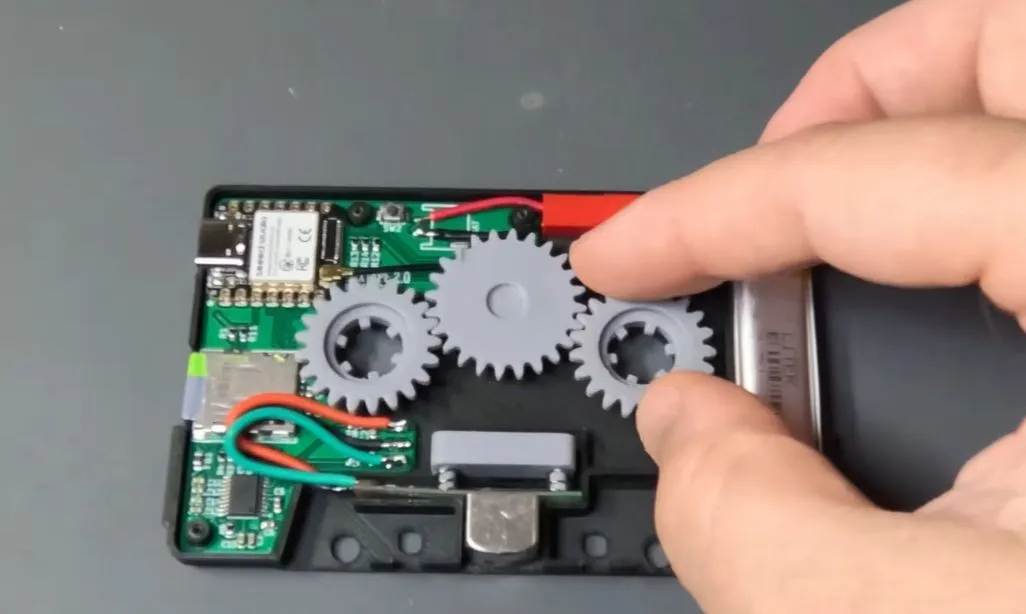
Jonathan Rowny built a self-contained MP3 player housed inside a standard cassette shell, designed to output audio directly to a tape deck's magnetic read head via an ESP32-S3 module, a microSD card reader, and a PCM5102 I2S audio codec.
The hard part is not the audio signal. It is the mechanics. Cassette decks expect spinning spools, and their auto-stop and reverse mechanisms will trigger if motion is absent or unbalanced. Rowny solved this with SLA-printed gears that simulate spool movement and transfer motion between reels, keeping the deck's logic satisfied. What he missed: the capstan, the pinch-roller-driven shaft that actually regulates tape transport speed, was not monitored. Better commercial adapters do track it, and his does not yet.
The full build video is worth watching for the mechanical problem-solving alone, not just the electronics. Rowny acknowledges the capstan gap and signals a future revision. If you ever wondered why those cheap cassette Bluetooth adapters skip or trigger auto-stop, this project explains the exact failure mode in hardware you can see and print yourself.
[READ ORIGINAL →]