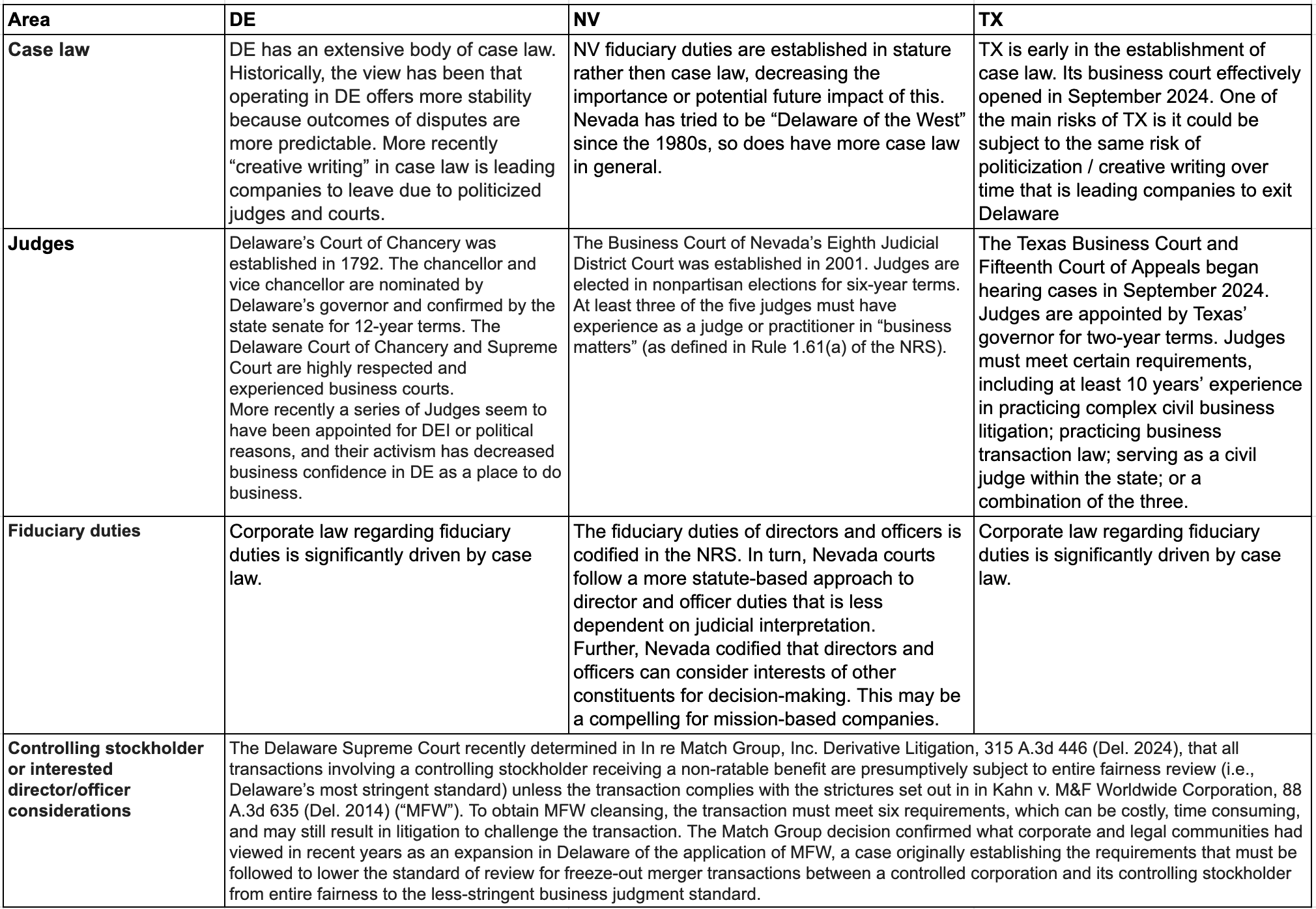
Delaware hosts over 1.8 million business entities despite a population under 1 million, including 60% of Fortune 500 companies. That dominance is eroding. Tesla reincorporated to Texas with 84% non-controller shareholder support after a Delaware court invalidated a board-approved, then shareholder-approved, compensation package for Elon Musk. SpaceX, Dropbox, TripAdvisor, and others have followed or announced plans to follow. The destination states are Nevada and Texas, with Nevada's statute-based fiduciary duties offering a specific structural advantage: less exposure to the kind of judge-made 'creative writing' that destabilized Delaware's reputation for predictability.
The case against Delaware is not one ruling. It is a pattern. A Delaware court invalidated Activision's merger approval process despite 98% shareholder support and no evidence of harm. It required special committee approval for Trade Desk controller transactions that were fully disclosed at IPO. It struck down Moelis and Company's founder stockholder agreements, also disclosed at IPO, requiring a legislative fix. It ruled that TripAdvisor's mere act of reincorporating to Nevada required minority shareholder approval because reducing litigation exposure counted as a 'non-ratable benefit' to the controller. Latham and Watkins partner Ben Potter's state-by-state comparison, linked in the original post and available as a PDF, maps exactly where each jurisdiction wins and loses on litigation risk, D and O indemnification, takeover defenses, and business judgment rules.
The structural question the original post forces is whether Nevada's statute-based approach actually delivers the predictability Delaware once promised, or whether Texas's scale and political momentum make it the more durable choice. That tension, plus the reincorporation process itself, is what makes the full piece worth reading. Companies still sitting in Delaware without a plan are making a decision by default.
[READ ORIGINAL →]