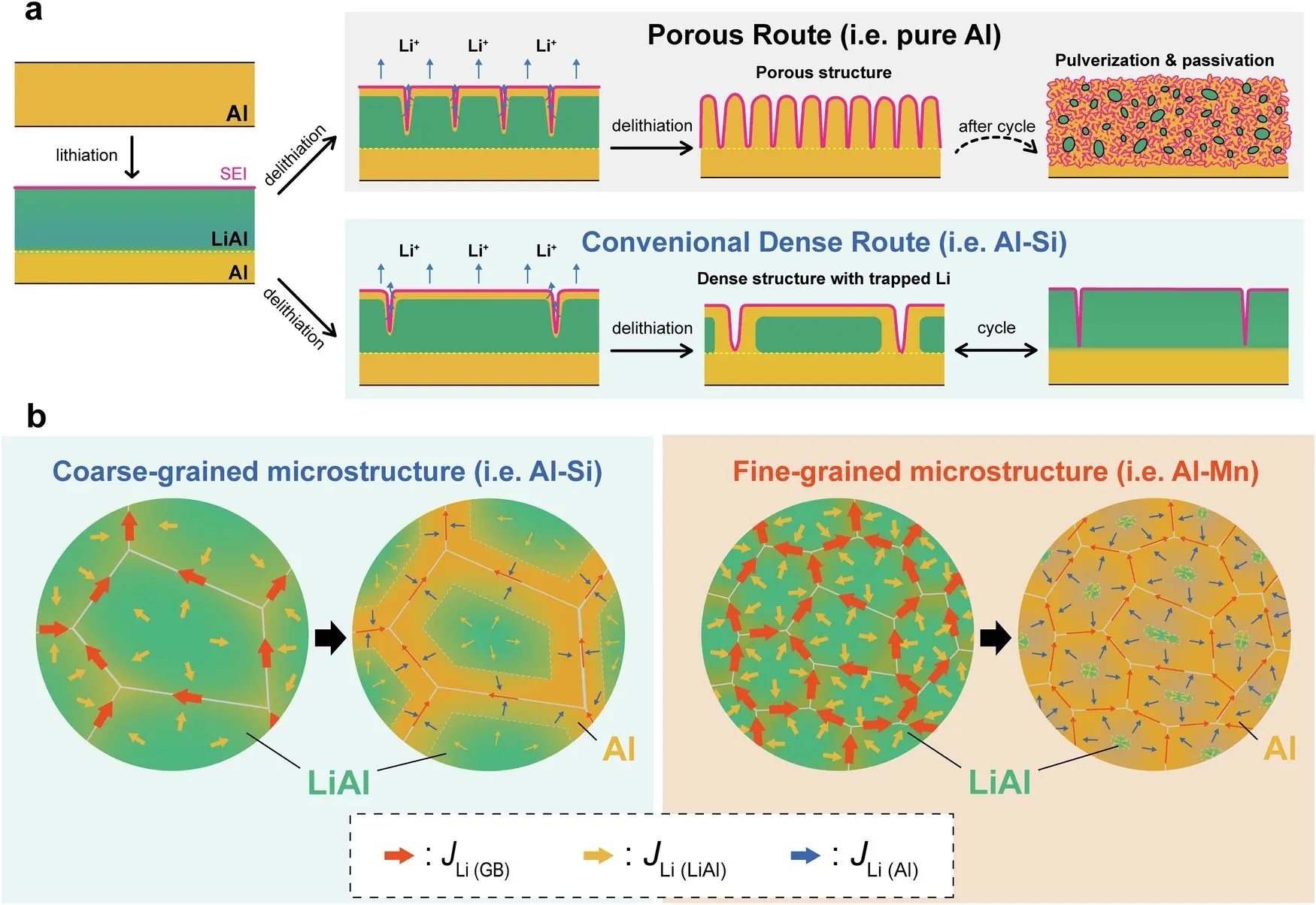
Aluminium anodes for lithium-ion batteries hold significantly higher capacity than standard graphite, but they fail due to volumetric expansion when lithium forms Li-Al compounds during cycling. Yuki Nakata et al., publishing in Communications Materials, show that alloying aluminium with manganese suppresses the formation of lithium-depleted surface regions, the root cause of crack and pore formation that destroys bare Al anodes over repeated charge cycles.
The core mechanism matters here: in plain Al foil anodes, lithium gets trapped below a depleted surface layer, forcing delithiation through destructive cracking. The Al-Mn alloy disrupts this process directly. Surface degradation is still visible after dozens of cycles, so this is not a finished solution. The authors point to surface coatings as the likely next step to handle residual stress from volumetric change.
Read the full paper for the electrochemical characterization of the Li-depletion mechanism and the specific structural analysis of how Mn changes alloy behavior. A 2026 overview by Serban et al. in Coatings provides the broader context on competing anode materials including silver and magnesium. Al-Mn is not ready for production, but the failure mode is now better understood and a path forward is defined.
[READ ORIGINAL →]