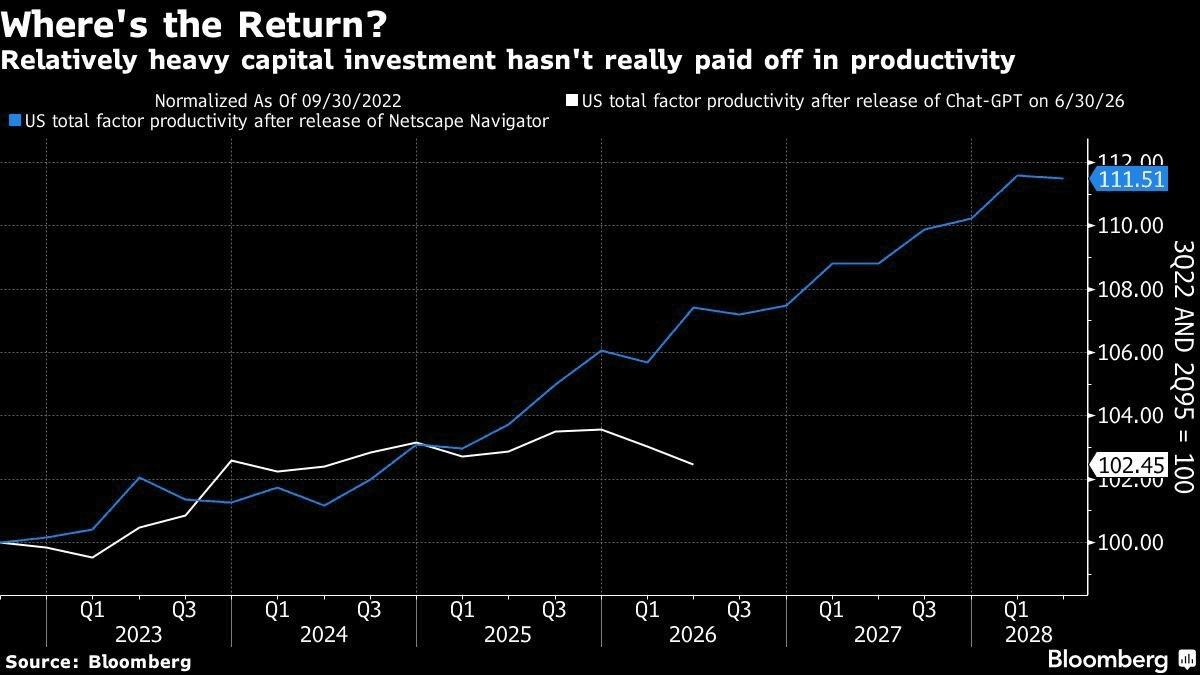
The AI bubble is not a technology story. It is an accountability story. Ed Zitron's 'Hyperscale Normalization' opens with Adam Curtis's 2016 documentary 'HyperNormalisation' as its framework: politicians, financiers, and technologists stopped solving problems and started manufacturing realities stable enough to delay consequences. Zitron applies this directly to the current AI investment cycle, where the same pattern that produced the Iraq WMD case, the 2008 financial crisis, and WeWork's fraudulent $47 billion valuation is now running through NVIDIA, Anthropic, and OpenAI.
The piece earns its length by tracing accountability failures across decades with specific names and numbers. Adam Neumann raised $350 million after lying WeWork to a $47 billion valuation. Blackwater, after the 2007 Nisour Square Massacre that killed 17 civilians, rebranded through three corporate identities, became Constellis, and won a $10.3 billion US Army contract. The venture capital industry, which barely returns a dollar per dollar invested, continues raising billions. These are not analogies. They are the operating model Zitron argues the AI industry has inherited.
The article is not finished making its case in the sections excerpted here. The Curtis framework is the on-ramp, not the destination. Zitron is building toward a specific argument about circular financing in the AI sector, with a premium finale covering the full history and current practitioners beyond NVIDIA. Read the full piece to follow the chain from Iraq to Bear Stearns to your GPU cluster.
[READ ORIGINAL →]