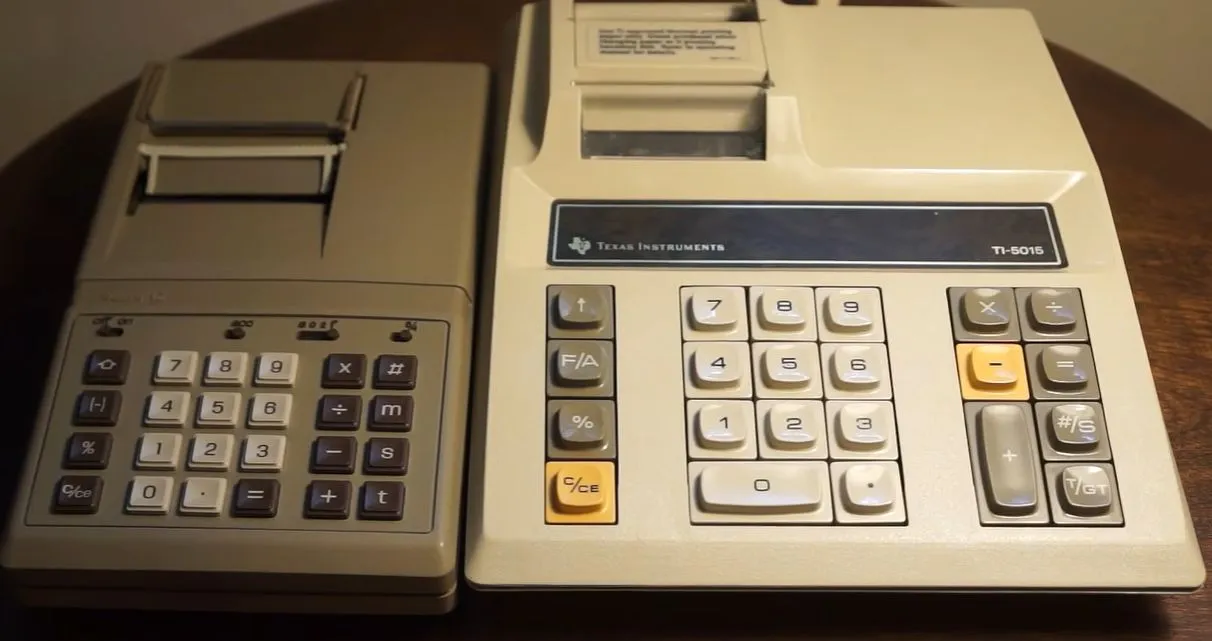
The 1970s Sears 12 calculator doubled its thermal print head resolution by physically wiggling the head side to side, cutting the required heating elements, and therefore cost and driving circuitry, by roughly half. The competing Texas Instruments TI-5015 used a fixed print head and needed twice as many elements to achieve the same dot density. The Sears 12 ran on a Mitsubishi M58671 calculator IC and used the mechanical oscillation of the entire print head assembly to fill in the gaps between element positions.
Danalog's teardown video shows the print head moving visibly and rapidly with the cover removed, making the trick immediately obvious. The side-by-side output comparison with the TI-5015 is the key evidence here: the Sears 12 matches or beats print quality at lower component cost. The tradeoff is timing drift during extended print sessions, which produces slightly wavy output as the mechanical oscillation falls out of sync with the print timing.
The engineering question the original video answers in detail is how the timing logic accounts for the moving head, and where exactly the drift originates. That mechanical-software coordination, done in 1970s consumer hardware with no microcontroller, is what makes this worth watching in full.
[READ ORIGINAL →]