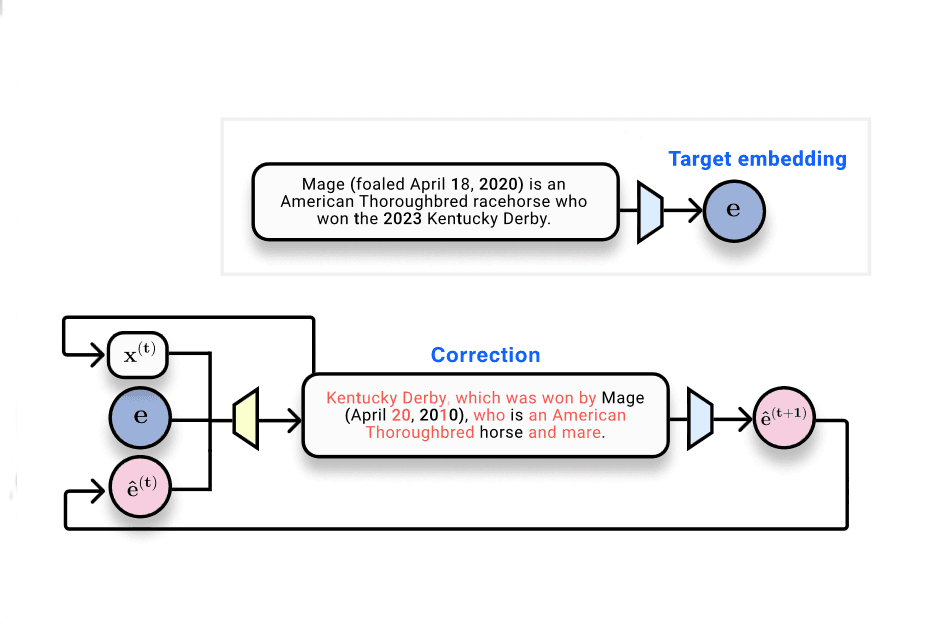
Vector databases are leaking your data. That is the core finding of 'Text Embeddings Reveal As Much as Text' (EMNLP 2023), a paper that demonstrates input text can be recovered directly from the embedding vectors stored in systems like Pinecone, Chroma, and Weaviate, startups that together have raised hundreds of millions of dollars on the promise that RAG pipelines are a safe, scalable way to query private documents. Engineers building these systems often assume that storing vectors instead of raw text provides a layer of privacy. That assumption is wrong.
The paper attacks this problem from first principles. Text embeddings are the output of neural networks: token vectors averaged into a single fixed-size vector after passing through stacked nonlinear layers including ReLU activations, which set all negative values to zero. The data processing inequality from signal processing confirms that each layer can only lose information, never add it. Conventional wisdom says deeper layers build richer representations, but they cannot encode anything not present in the original input. The paper uses this theoretical constraint to argue that embeddings must retain recoverable traces of source text, then proves it empirically through inversion attacks analogous to earlier image-model inversion work by Dosovitskiy (2016), which reconstructed recognizable images from CNN feature vectors.
The specific inversion method, the exact fidelity of recovered text, and the conditions under which reconstruction succeeds or fails are what make this paper worth reading in full. If you are deploying a RAG system and assuming embedding vectors are an anonymized or protected representation of sensitive documents, this paper is a direct challenge to that assumption. The privacy implications for enterprise vector database deployments are immediate and unresolved.
[READ ORIGINAL →]