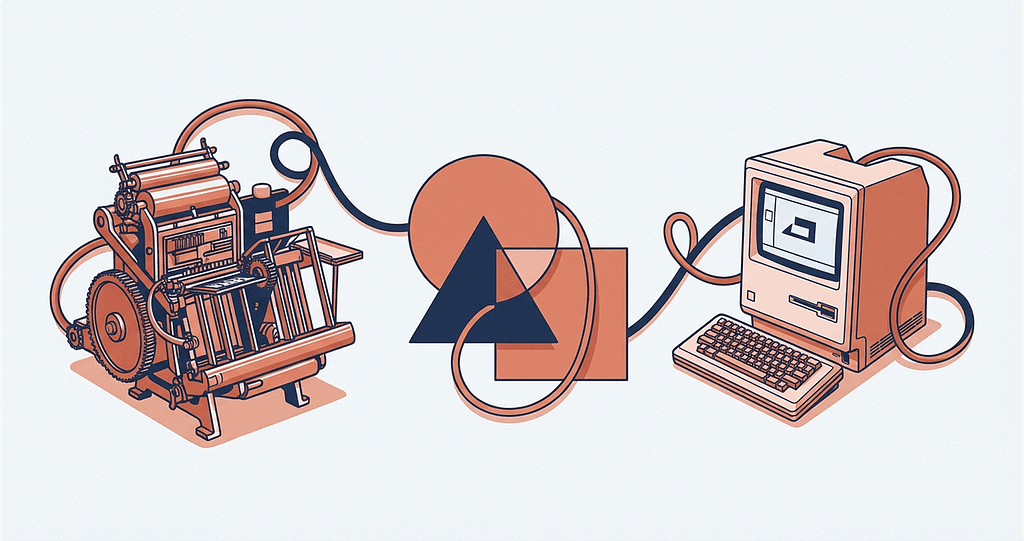
Disruption has a shape. The printing press, the Bauhaus closure, and desktop publishing all followed the same arc: democratisation, quality collapse, panic, then new norms. This UX Collective piece by way of design history argues that AI is not an exception. It is the next iteration of a pattern that has repeated across five centuries. The numbers anchor the argument: within 50 years of Gutenberg, 20 million books circulated in Europe. By 1600, 150 million. The same press that enabled the Scientific Revolution also industrialised witch-trial pamphlets. Access without gatekeepers does not guarantee quality. It never has.
The most useful section is not the conclusion. It is the desktop publishing case from 1985. Aldus PageMaker and the Apple LaserWriter arrived together, unionised typesetters lost their jobs en masse, and a decade of Comic Sans business cards followed. The profession did not die. The value proposition shifted from technical execution toward strategic thinking and taste. The barriers did not disappear. They relocated. That relocation is what the piece is actually about, and it is the frame worth applying to every current conversation about AI and design roles.
The article stops just before answering its own sharpest question: where do the new gatekeepers land once baseline execution becomes a commodity? That gap is deliberate, and it is reason enough to read the full piece. The historical scaffolding is tight, the Bauhaus diaspora section in particular reframes suppression as distribution in a way that has direct implications for how distributed AI tooling might spread design capability globally. The arc is clear. The landing point is still being negotiated.
[READ ORIGINAL →]