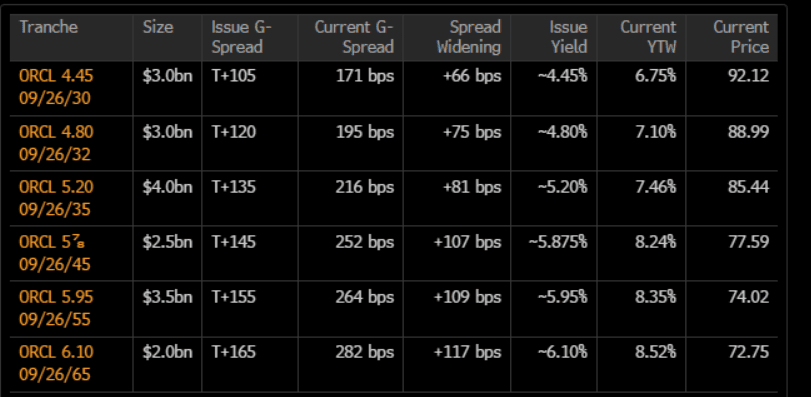
10-year Treasury yields have climbed past 5.3% and are still selling off. Every company building AI infrastructure, from Anthropic to SoftBank to Meta, borrows against that benchmark. When the risk-free rate rises, every dollar of junk-rated debt gets more expensive. Anthropic holds $413 billion in non-cancellable compute contracts. $18 billion in Oracle data center debt is already trading at 84 cents on the dollar. These are not abstract figures.
OpenAI and Anthropic will need at least $50 billion in new debt annually, almost certainly at low-grade junk credit ratings. The market has priced in a world where both companies go public, grow indefinitely, and service that debt without incident. This piece explains, methodically, why that assumption does not survive contact with how bond markets actually work. The explainer on Treasury auctions, competitive bids, and yield mechanics is not filler. It is the foundation for the argument that follows.
Ed Zitron is building toward a two-part analysis of AI debt, with a follow-up piece on junk debt and what happens when a hyperscaler's credit rating collapses. If you want to understand the specific mechanism by which the AI infrastructure build-out could seize up, read the original. The numbers are already in the market. Most people have not done the arithmetic.
[READ ORIGINAL →]