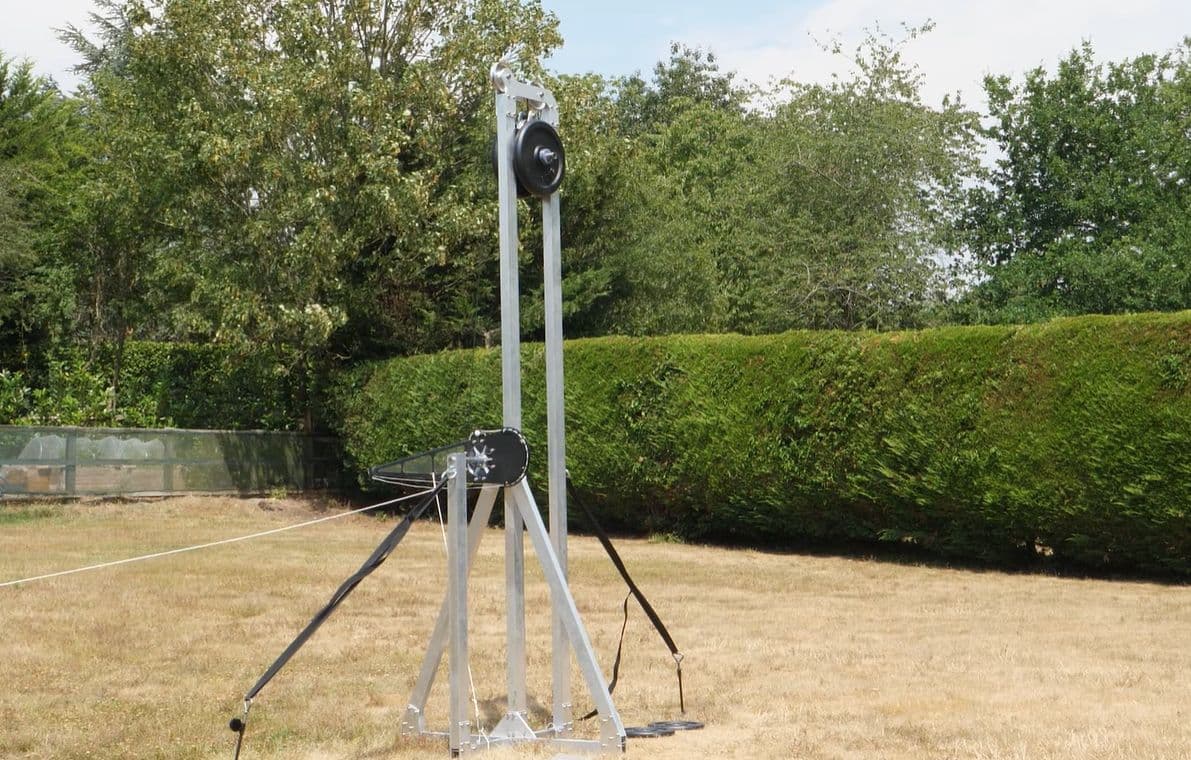
Tom Stanton built a trebuchet that broke the sound barrier. A 4-gram projectile launched by a 40 kg counterweight reached 346.4 m/s (1,249 km/h), clearing the 1,235 km/h threshold with an audible sonic crack. The arm hit 2,342 rpm at the moment of release.
Getting there required solving two hard problems. First, Stanton wound the projectile rope around the arm for extra velocity multiplication and added a gearing system to extract more energy from the falling weight. Second, the arm now spins through multiple rotations before release, compressing the valid launch window to 0.0025 seconds. A mechanical latch inside the drum, triggered automatically when the counterweight rope fully unwinds, handles that timing without any electronics. The first 10 kg test hit 528 km/h. After aerodynamic redesigns, the same weight produced 634 km/h. The first 40 kg run reached 1,152 km/h at 39% system efficiency, with components visibly failing.
The full video documents every design iteration and failure mode between 528 km/h and supersonic, which is where the real engineering story lives. Read the original Hackaday writeup, then watch the video to see what 2,342 rpm looks like on a medieval siege weapon.
[READ ORIGINAL →]