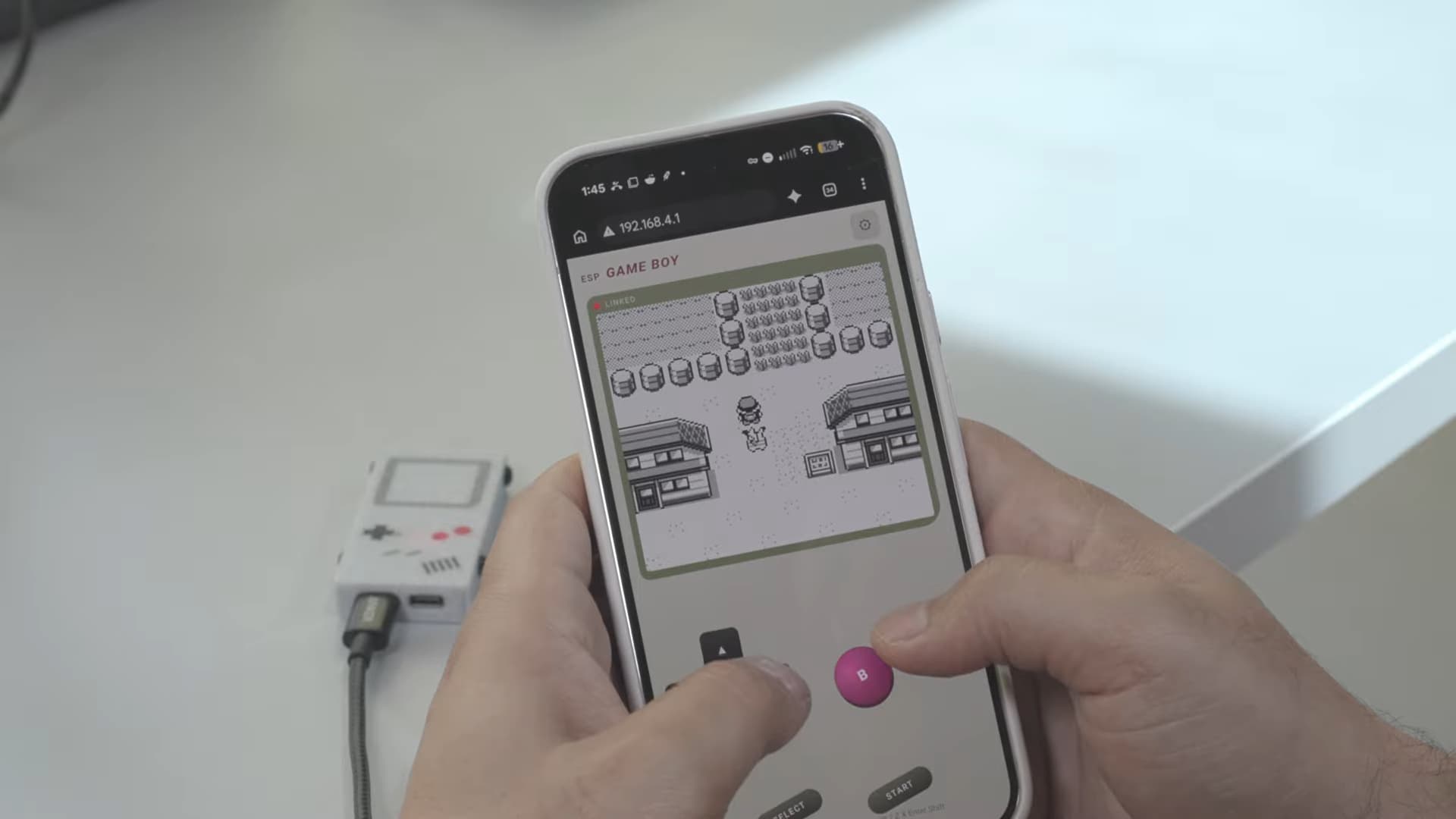
A developer called Artificial-Age has built a Game Boy emulator that runs entirely on an ESP32-S3 microcontroller, with no screen and no physical buttons. The device hosts its own WiFi access point. Anyone within range opens a browser, gets a live stream of emulated video and audio, and sends input via keyboard or touchscreen. No app installs, no configuration.
The original Game Boy runs at roughly 4 MHz on an 8-bit processor, well within what an ESP32-S3 can handle. ROMs live in the microcontroller's onboard flash storage and can be uploaded through the same web interface used to play. The entire stack, emulation core, WiFi AP, web server, and AV streaming, runs on a single cheap chip.
The point is not raw performance. Any smartphone can already run a Game Boy emulator. The point is zero-friction sharing: one device, one network, anyone joins. The GitHub repository is public. What makes the full project worth reading is the architectural decision to strip the display and input hardware entirely and route everything through a browser, and how the author solved audio streaming latency on embedded hardware.
[READ ORIGINAL →]