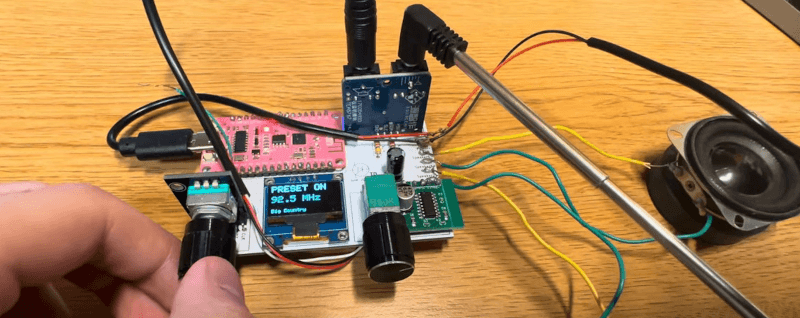
The TEA5767 FM tuner chip takes RF in and outputs stereo audio with zero adjustment. Builder turtushig22-blip has published an open hardware design pairing the TEA5767 breakout board with an ESP32, an OLED display, a rotary knob, and an external amplifier. The full schematic and code are on GitHub.
Control is via I2C or 3-wire serial. You send a 5-byte control word, the chip returns 5 status bytes. Frequency is set by PLL divisor, not Hz directly: tuning 100.1 MHz with a 32 kHz reference crystal requires the value 12247. The chip uses a 225 kHz IF, supports autonomous station seeking with configurable signal strength threshold, and can select positive or negative mixer output for image rejection.
Limitations are real: no RDS or RBDS decoder means no station metadata on the display, and audio output is analog only. The original article is worth reading for the PLL math walkthrough and the distinction between this ESP32 PCB design and the earlier Arduino UNO iteration, which shows how much the peripheral complexity changed between builds.
[READ ORIGINAL →]