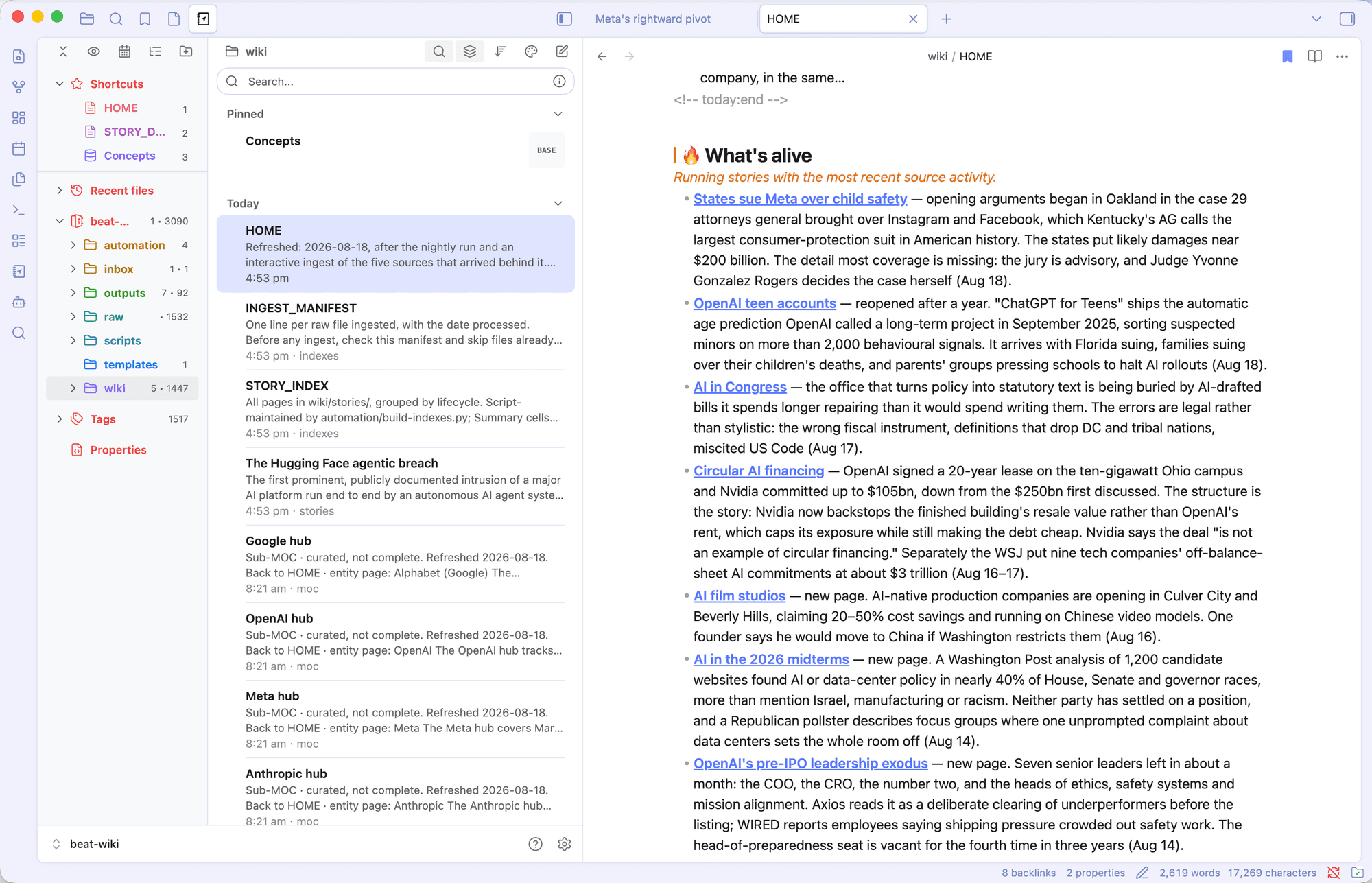
Andrej Karpathy, the researcher who coined 'vibe coding,' posted in April about building personal knowledge bases with LLMs: drop source documents into a local folder, let an LLM extract and organize the contents into a Markdown wiki, update it as new material arrives. Within hours, GitHub repos and YouTube tutorials flooded the web. Casey Newton, writing for Platformer, caught the idea and spent the next several weeks building his own version. His verdict: of every productivity experiment he ran this year, the LLM wiki was the most useful.
The piece is structured as Newton's annual productivity audit, which makes it worth reading in full because the wiki finding is embedded in a larger argument about what actually sticks. Raycast, using GPT-5.5 Instant for quick AI queries, remains on his machine. Capacities still handles his daily journal and tagged news archive. Recall survives only as a YouTube transcript tool. Two things he quit, including Notion's agentic search, failed not because they didn't work but because they required too much effort to operate and only looked backward. The wiki, by contrast, grows forward.
Newton is candid: the LLM wiki demands maintenance and easier knowledge-base tools exist. But his framing, that it functions like a good research assistant for anyone doing research-heavy desk work, is specific enough to be testable. The full piece details his actual folder structure, his prompting approach, and the specific failure modes he encountered building it. If you do any work where institutional memory is a bottleneck, that operational detail is the reason to read the original.
[READ ORIGINAL →]