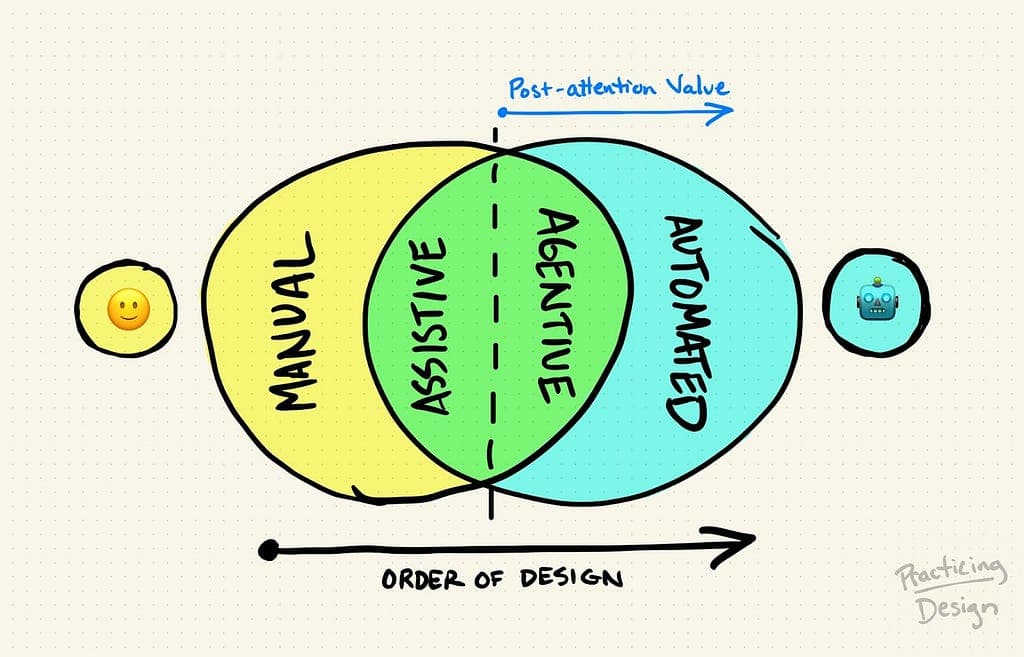
Generative AI is restructuring design agency economics. A single engineer can now manage 20 to 30 parallel autonomous agents, each capable of setting up environments, writing tests, and producing deployable artifacts from a high-level specification. The industry has entered what researchers call software's third age: a shift from writing instructions to defining intent. The designer's role is moving from creator to orchestrator, and agencies that miss this transition are already behind.
The risks are structural, not cosmetic. Research using the Kano Model's better-worse coefficients shows that data privacy failures destroy client trust regardless of output quality, while high-value differentiators like novel hypothesis brainstorming remain out of reach for agencies running one-size-fits-all pipelines. The Technology Acceptance Model adds another constraint: AI tools must demonstrate measurable improvement in decision-making, not just speed, before organizations commit to long-term adoption. Top management support is the primary catalyst. Without it, even capable tooling stalls.
The full piece is worth reading for its breakdown of all three generations of AI integration, from autocomplete to autonomous agents, and for the quantitative Kano analysis of specific AI service demands and where automation actually moves the needle on satisfaction. The brand homogenization risk and technical debt accumulation arguments are grounded in sourced research, not intuition. If you are deciding how much to automate and what to protect, this framework is the most structured treatment available right now.
[READ ORIGINAL →]