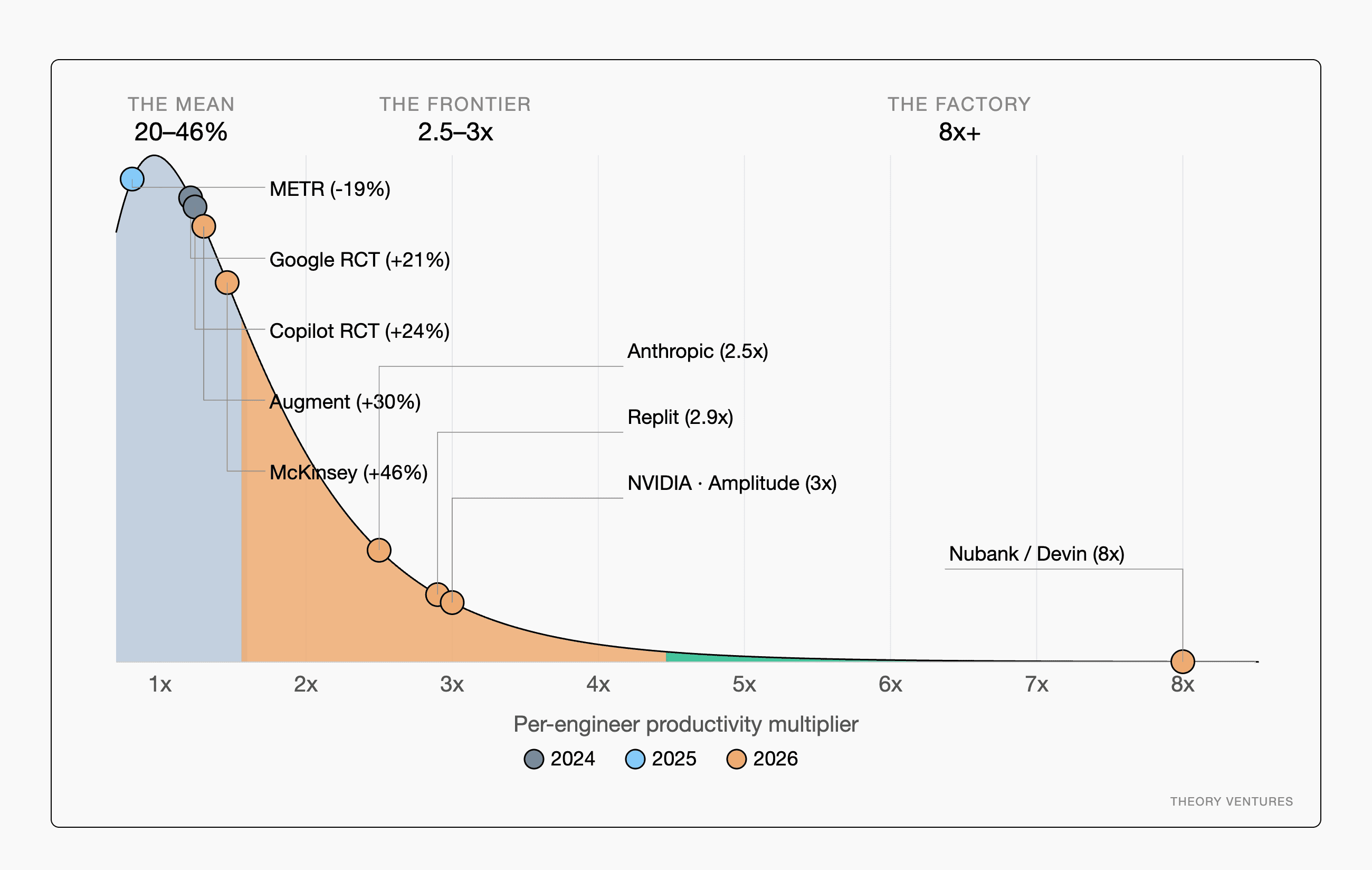
The productivity gap between AI-augmented engineering teams is not a spectrum. It is a trimodal distribution. NVIDIA's 30,000 developers committed 3x more code with flat bug rates. Anthropic's internal teams wrote 2.5x more code per engineer using Claude Code. Replit tripled per-engineer output while keeping reversions, review times, and incidents flat. These are not the average outcomes. They are the ceiling of what deliberate AI integration produces.
The average outcome is 20 to 30 percent. Google's randomized controlled trial with roughly 100 engineers found 21 percent. GitHub's study across 450 developers at a large fintech found 24 percent. Faros telemetry across 22,000 developers found epics completed 66 percent faster, but bugs per developer up 54 percent. Augment Code put it plainly: leaders expected 2-3x and landed at 30 percent. This is what happens when a company hands out an AI IDE and changes nothing else. The article's value is in naming exactly why these two populations, the 20 percent cohort and the 3x cohort, are operating under fundamentally different system designs, not different tools.
The third tier is the one to watch. Cognition's Devin delivered 8x engineering efficiency and 20x cost reduction for Nubank on large-scale refactoring. Factory.ai is running software factories at NVIDIA, Adobe, Blackstone, and EY. Goldman Sachs is piloting Devin alongside 12,000 human developers and publicly estimates 3-4x gains over prior tools. The original piece maps the architectural decisions that separate a 30 percent footnote from a 5.8x total code contribution number. Read it for that map.
[READ ORIGINAL →]