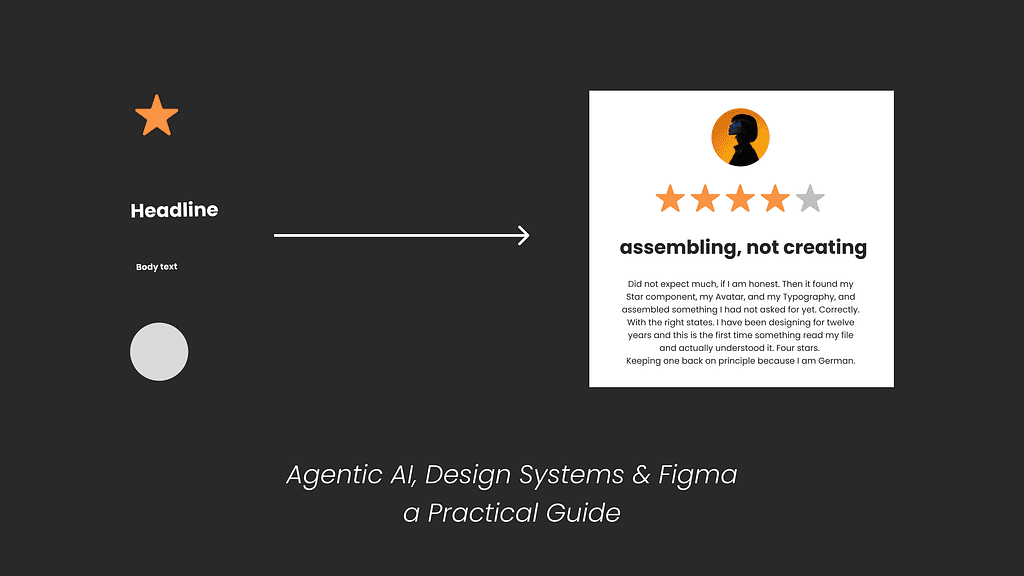
Brad Frost and Dominic Nguyen demoed Storybook's MCP-in-progress at a session called Agentic Design Systems in 2026. A developer typed one prompt: 'Add a customer reviews component.' The agent located a Star component, Typography, and an Avatar, read their props, understood their states, composed a new component, wrote the code, and wrote the tests. No Figma frame. No Jira ticket. The whole sequence finished faster than the ticket would have taken to write.
The implication is structural, not cosmetic. The design system is no longer documentation for developers. It is instructions for a machine that reads exactly what is there, no interpretation, no back-and-forth. Semantic tokens, consistent naming, and complete component states, the basics design systems practitioners have preached for years, are now the literal foundation for what an agent can build. The designer who defines what components exist, what states they carry, and what they are called controls the creative outcome more directly than ever. But the article makes a sharper point than that: good components cannot be extracted from a library maintained in isolation. They come from a designer who designed the whole page first, saw how the Star component related to surrounding typography, and distilled that finding into a reusable part. Skip that process and you get a structurally correct, visually generic system, which is exactly what most vibe-coded and Tailwind-default interfaces already look like.
The piece runs through the practical Figma file setup required to make this work, covering Variables beyond a flat hex palette, semantic token layers, component states, and naming conventions, with a specific warning that the agentic setup will pull toward assembly efficiency unless designers actively protect the creative process upstream. The checklist is worth reading in full, but the argument underneath it is the more important thing: the messy, non-linear work of designing a whole page before extracting components is not overhead. It is the only thing that makes the machine's output worth anything.
[READ ORIGINAL →]