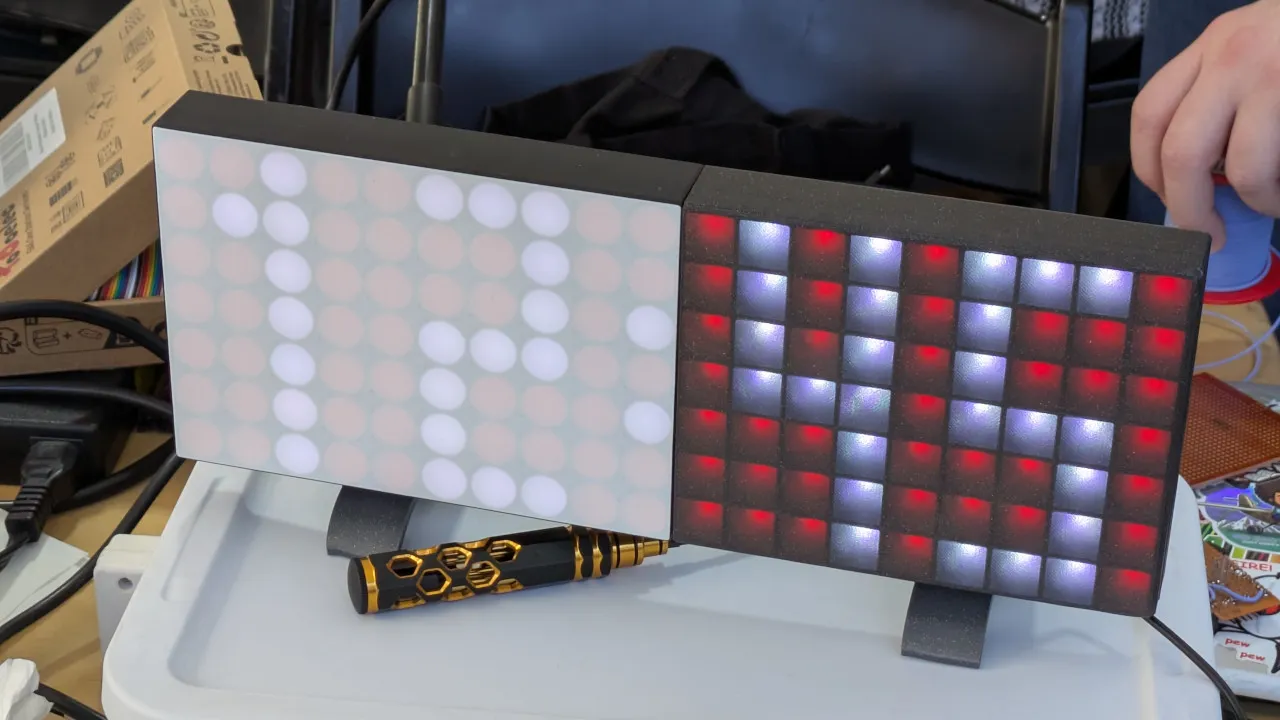
Dom Dominici's PixelClock eliminates the most tedious step in LED matrix builds: cutting and wiring. A single continuous 2.5-meter WS2812B strip threads through a 3D printed frame to form a 7x19 pixel display, no soldering required beyond connecting the strip's endpoint to an ESP32 WROOM dev board.
The design debuted at Hackaday Supercon 2026 with a stated goal of accessibility. Configuration runs through a web interface hosted on the ESP32 itself, no app install needed. Firmware flashes over WebSerial. The diffuser panel is not acrylic or paper, it is two layers of printed plastic, swappable mid-print for color variants. Individual LED compartments can be reshaped in CAD to create custom pixel geometries.
The full Printables listing covers the structural logic of routing a strip through folded channels without manual intervention, and the tradeoffs of hiding a few LEDs inside the folds. If you build LED displays or design for first-time makers, the routing approach alone is worth studying.
[READ ORIGINAL →]